
A recent meeting regarding the railroad siding (second rail) proposed by the LOSSAN rail corridor agency along Padaro Lane was reportedly heated, with residents in opposition—particularly because the plan will result in the removal of over 100 trees. Can you tell us more about the project? —B.
LOSSAN, shorthand for the Los Angeles–San Diego–San Luis Obispo Rail Corridor Agency, which oversees the rail corridor from San Diego to San Luis Obispo, has long planned on “adding approximately one mile of new siding track alongside the existing rail line [in order to] create a critical ‘passing lane’ for trains, improving reliability and schedule flexibility,” according to LOSSAN’s Ortega Siding project website.
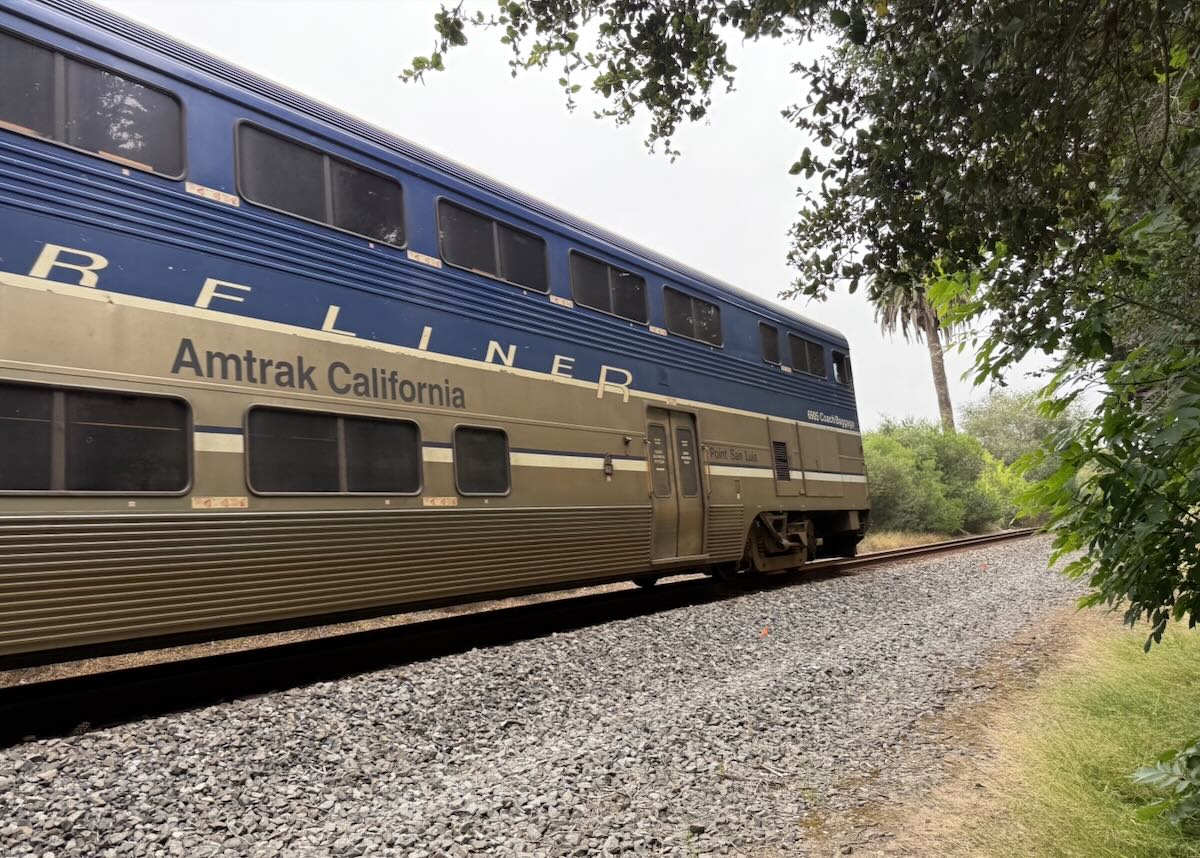 The Ortega Siding Project Study Report (June 2023) has more on the benefits of the “passing lane”: “The 16.7-mile single-track segment between CP CO385 (Seacliff) and CP CO369 (South Santa Barbara) greatly diminishes the railroad’s ability to increase service. Within this segment, trains are unable to operate bidirectionally. Trains must wait in one of the aforementioned sidings [Seacliff and Santa Barbara] until a train traveling in the opposing direction clears the track.”
According to the same report, “the goal for this segment of the corridor is to have a two hourly pattern for Pacific Surfliner service between Los Angeles Union Station and Goleta.”
There was once a siding west of Padaro Lane, south of Summerland, but it was “damaged by erosion, landslides, and sink holes on the ocean front cliffs during heavy rain events in the late 1970s. Most of the siding was taken out of service and removed in the early 1980s. The new proposed siding location is further inland to the east and would be protected against coastal erosion, landslides, and sea level rise that the old historic Ortega siding succumbed to.”
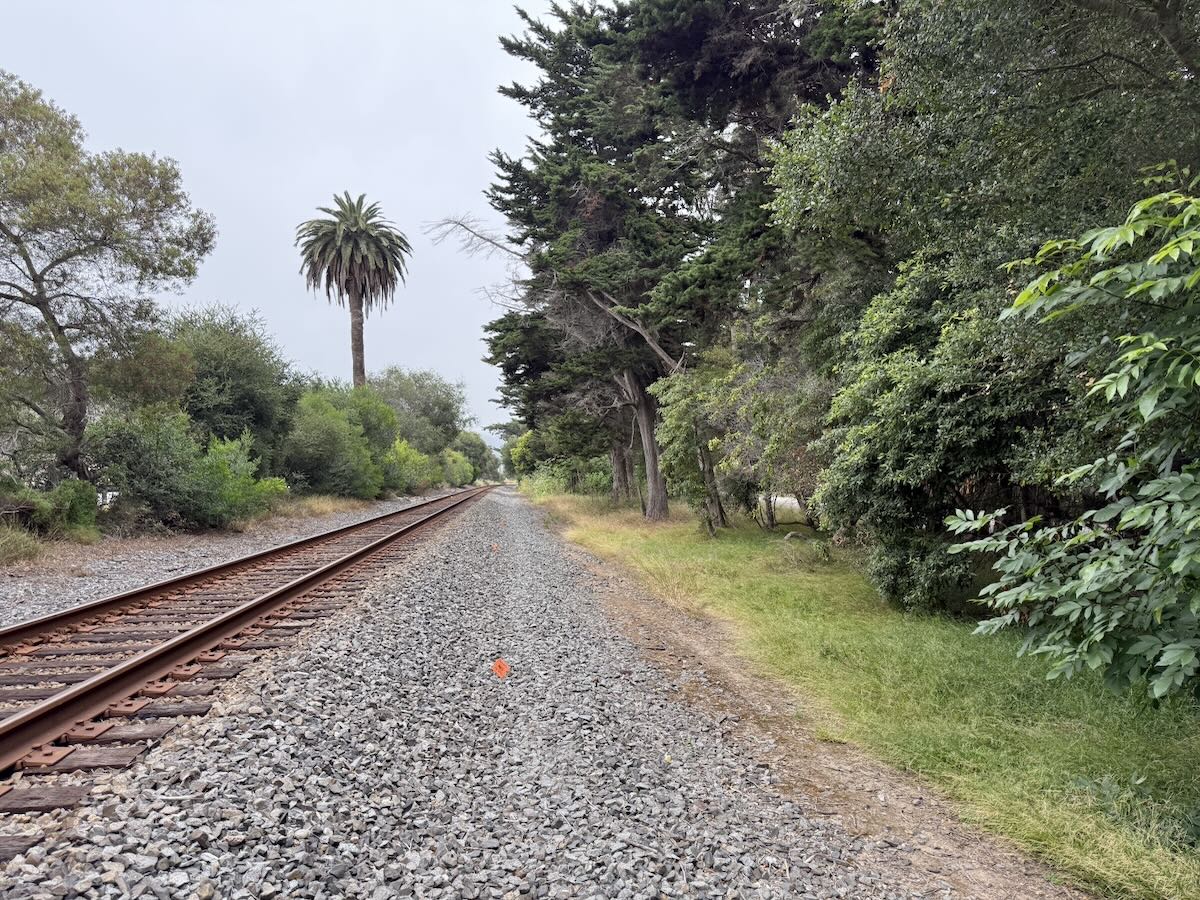
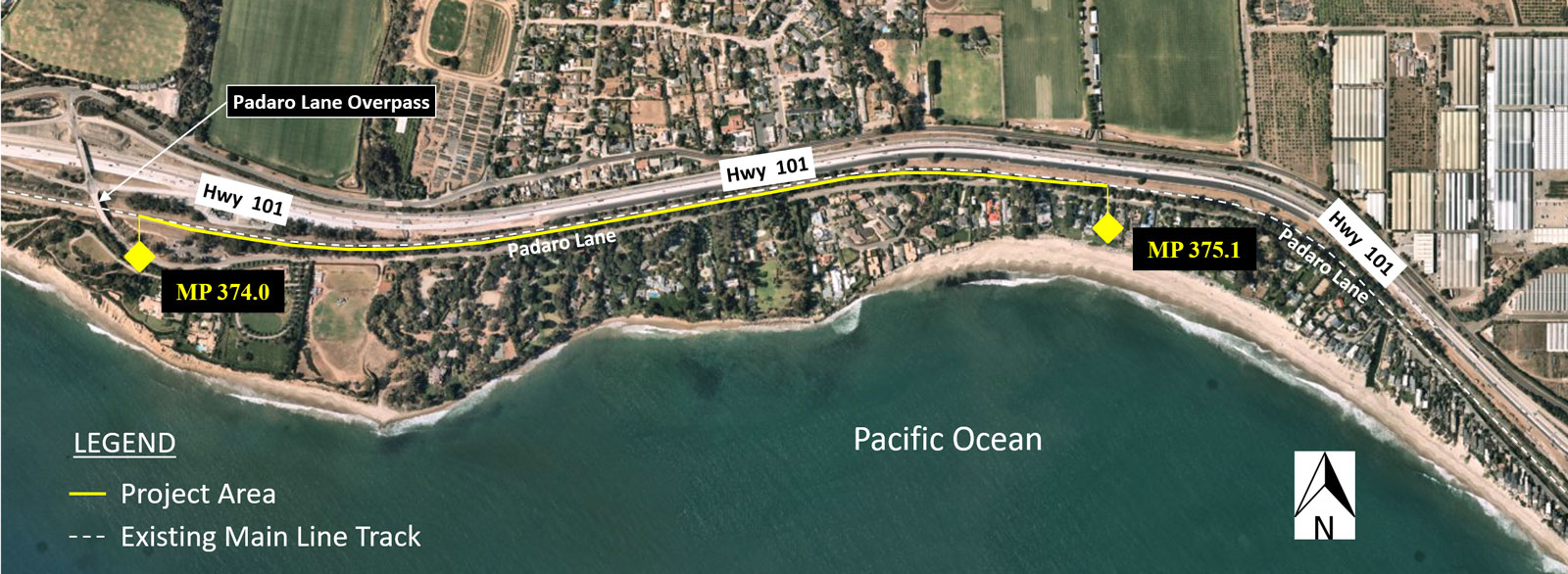
The new track would be constructed within the existing Union Pacific right-of-way, on the south side of the existing tracks roughly from the Loon Point parking lot to 3355 Padaro Lane. LOSSAN says that the total width of the new siding would be 30 to 40 feet, depending on the terrain.
 Padaro Lane residents understandably have concerns, including air pollution, noise pollution, fire risk, and derailments. Perhaps most of all, how many trees would be cut down? As you can see in the drone footage below [Update 7/9: the video was removed from YouTube], many trees, or even most of the trees on that side of the street, encroach on the 30-40 feet of clearance. A LOSSAN rep emailed me that “the design phase of the Ortega Siding project is on hold until our capital projects team completes a tree survey. We don’t know if trees, or how many trees, may be impacted as part of this project until that survey is over. We’re anticipating having more information in the fall.” (The Ortega Siding is exempt from California Environmental Quality Act requirements because it “would support mass transit passenger rail operations conducted by the LOSSAN Rail Corridor Agency on a rail line already in use.”)
LOSSAN materials cite “a growing demand for service to Santa Barbara, Goleta, and San Luis Obispo” as the reason for the new siding, but residents have yet to be convinced that it’s necessary, so I asked the rep for numbers to back that assertion up. The response:
Within Santa Barbara and San Luis Obispo Counties specifically, ridership increased approximately 1% from FY24 to FY25 and is projected to grow by approximately 20% from FY25 to FY26. Since February 2026, ridership at stations within those two counties has increased by approximately 35%, coinciding with the addition of new service and increased travel options for passengers.
In FY25, approximately 509,500 passengers boarded or deboarded Pacific Surfliner trains at stations in Santa Barbara and San Luis Obispo Counties. In FY26, that number is projected to increase to approximately 615,000 passengers.
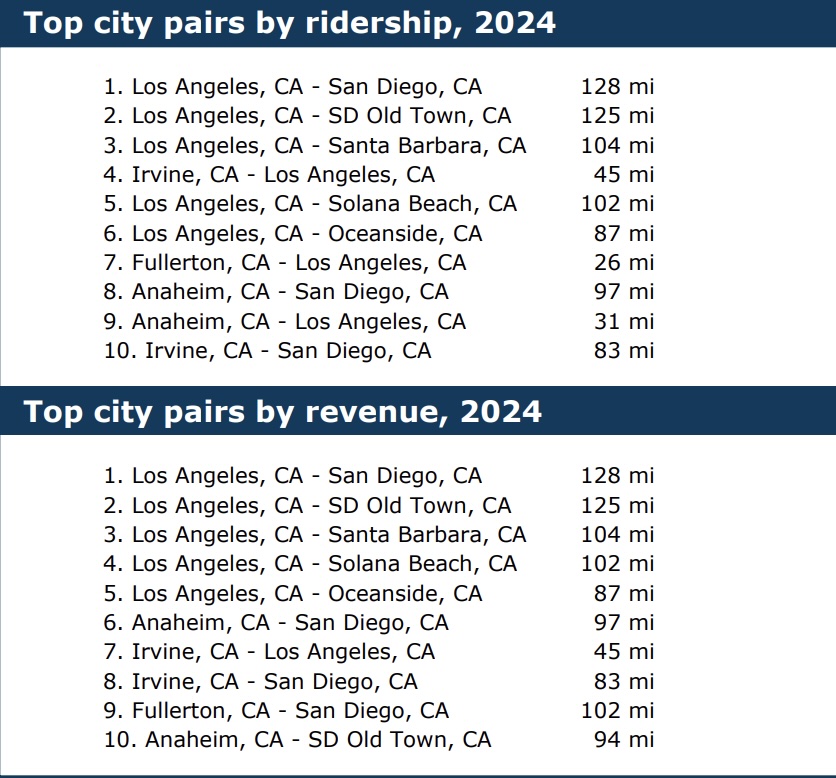
And yet the Times of San Diego reported last November that while Amtrak ridership elsewhere in the nation has rebounded from a Covid-era dip, the Pacific Surfliner has not; it carried 2,776,654 riders in FY2019 (the final year before Covid), and only 2,043,059 in FY2025. And if the 2024 data in a Rail Passengers Association fact sheet is indicative of greater trends, traffic on the line skews highly toward points south of L.A.—which makes sense, given that the area between L.A. and San Diego is substantially more populous. (UPDATE 6/18: LOSSAN points out that the Times of San Diego did not account “for a significant service disruption between Jan-March 2024: the San Clemente coastal bluffs closure, which suspended rail service along that segment while OCTA repaired coastal erosion damage.” The flipside of that, of course, is that the revenue numbers would normally skew even more toward areas between L.A. and San Diego.)
LOSSAN’s presentation to Padaro Lane residents says that construction would start in mid-2028, pending approvals, and take around two years. You can sign up for LOSSAN email updates about the Ortega Siding project here. And the Padaro Association is working on a petition opposing the plan, which I’ll link to here when it’s ready. UPDATE 6/23: Here’s that petition.
Is there a question you’d like investigated? Email [email protected] or text 917-209-6473.
················
Previous Burning Questions:
••• Will you explain the plan to adapt the waterfront for climate change?
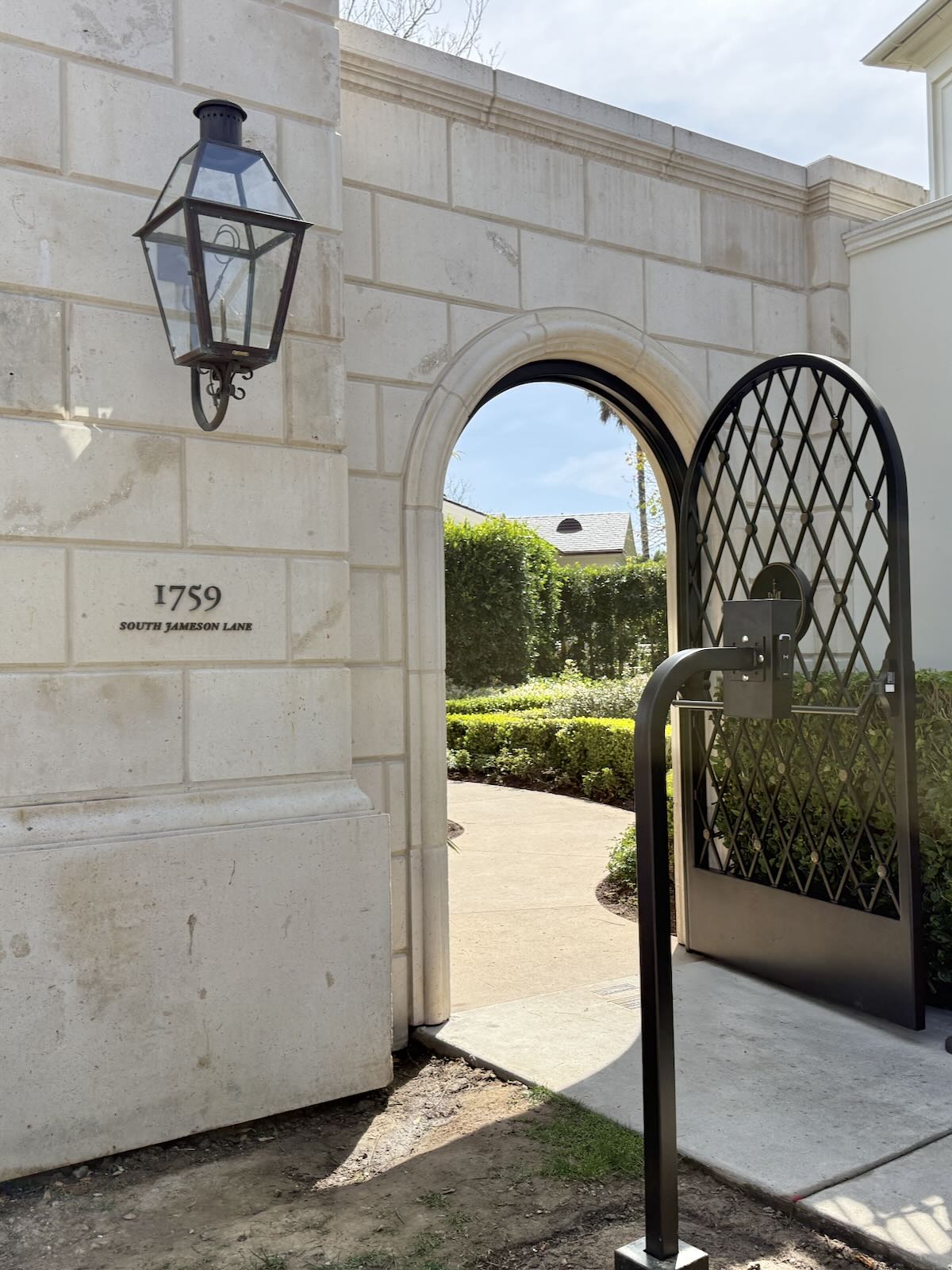
↓↓↓ Why did the Rosewood Miramar Beach install gates?
••• How long will this big pipe be at East Beach?
••• Is Cabrillo Boulevard going to be widened under Highway 101?
••• Was there a Fisherman Inn in downtown Santa Barbara?
••• What are those old buildings at the corner of Castillo and Montecito streets?
••• What’s this scaffold structure on Las Positas Road?
••• Why does street striping take so long to happen?
••• Why do rocket launches look the way they do?
••• How is the San Ysidro Debris Basin designed to work?
••• What’s this building on Helena Avenue?
••• What are those old pilings in Arroyo Burro Creek?
••• What’s this building under construction in Toro Canyon?
••• What’s the story behind the seal of the City of Santa Barbara?
••• Butterfly Beach steps, green power lines, SBAG license plates, and more
••• What’s this pole with a flashing blue light?
••• What are these sculptures on the Riviera?
••• What’s the origin story of this fence on Hot Springs Road?
••• Why is part of this West Beach mosaic covered in concrete?
••• What was the Weeping Willow Inn?
••• What does the “S” on certain chimneys stand for?
••• What’s the status of the decommissioning of Rincon Island?
••• What happened to the gas flame on Highway 101?
••• What do we know about the proposed apartment complex at 1 Hot Springs Road?
••• What’s the history of this tower on Ortega Ridge?
••• What’s up with these sculptures on a hillside in Summerland?
••• Is there a master plan for the new walking paths in Montecito?
••• Why are the Thousand Steps still wet?
••• What’s happening with Sola Street?
••• Why is this lot on Milpas Street still vacant?
••• Where else do cruise ships that visit here go?
••• What is this large memorial in Ennisbrook?
••• Who bought the former St. Mary’s seminary—and why?
••• What will happen to the SBPD building when the new building is completed?
••• What’s the story with this house on W. Cota Street?
••• What are those little houses on Santa Barbara Street?
••• What’s the point of this light pole near the freeway?
••• What’s inside Paseo Nuevo’s State Street tower?
••• What’s the point of these markings on Laguna Street?
••• Why is there a giant red shoe off Highway 101?
••• What’s up with the “no e-bike” signs on local trails?
••• Why is Franceschi House in a holding pattern?
••• What’s happening with this derelict house in Summerland?
••• Can you explain how sundowner winds work?
••• Why is there a pressure cooker attached to this utility pole?
••• What’s this concrete ramp thing on East Beach?
••• Why does “USA” get written on the street?
••• What are those poles in the ocean near the Ritz-Carlton Bacara?
••• Are people really allowed to set fires in the middle of Montecito?
••• What’s the story with the half-finished lot next to the Montecito Country Mart?
 ················
Sign up for the Siteline email newsletter and you’ll never miss a post.










The boomers will not be content, nor will the MAGAfication of montecito be complete, until every tree is replaced with a freeway lane, bike path, or rail line (or dirt sidewalk)
I am not a fan of removing trees but you are completely clueless in lumping rail mass transit in with freeway building. Such a NIMBY argument. We need less freeway construction and more train improvement. BUILD THE EXTRA TRACK!
I actually agree with you, much prefer this to the freeway expansion. But the tree loss is a real bummer. Folks should remember that it only took about 25 years for LA to transform from being mostly agricultural land to the LA of the 1970’s
You should remember that where you’re sitting right now used to be a tree, a field, or open land at some point. You benefit every day from development that required change. Just because you’re comfortable with the changes that happened before you got here doesn’t mean everyone else should be denied the opportunity to benefit from improvements today.
Instead of just complaining, go to a nursery, buy some trees, and plant some trees. There are solutions beyond typing comments online. Take action.
Trees are important. The cypress tree removed from the middle of the freeway is a huge loss, But sometimes that’s what progress looks like when you’re trying to improve transportation and make things flow smoother for people.
Just because you got yours doesn’t mean everyone else doesn’t have a right to get theirs.
That’s the mentality people criticize when they talk about privilege and NIMBYism. It’s easy to support growth when it benefited you and then oppose it when it might benefit someone else.
We need more transportation infrastructure, not less. We need things to move more efficiently, not stay frozen in time because change makes some people uncomfortable.
Also, relating every issue to MAGA is bizarre and honestly says more about your mental health than the topic being discussed. Not every disagreement is political, and not everyone who disagrees with you is part of some culture war. Constantly forcing everything through that lens just diminishes the conversation while feeling righteous to discriminate and hate against others. Not cute.
Hopefully you can understand the lesson here. Trees matter. Transportation matters. Growth matters. The answer isn’t to stop everything. The answer is to build what we need and replace what we lose whenever possible.
And more importantly never forget, just cause you already got yours, doesn’t mean that nobody else gets to get theirs.
Tony, I was just having a little fun with my morning coffee when I wrote that comment and didn’t mean to trigger anyone.
Regarding action, I try to be a good steward of the land and support local regenerative agriculture and ecological efforts.
I really don’t get the”just because you got yours doesn’t mean that nobody else gets theirs” thing. One of the main reasons to preserve the natural environment is for future generations – perhaps even when it goes against current growth needs.
And lastly, MAGA doesn’t have a great track record with the environment and LOVES concrete. Look no further than the Whitehouse rose garden. That’s more factual and political. Plus the “MAGAfication of Montecito” rolls of the tongue nicely. Give it a try!
I’d like to get this as a tattoo. Or maybe a billboard. Probably a billboard. Bravo, regardless.
“ You should remember that where you’re sitting right now used to be a tree, a field, or open land at some point. You benefit every day from development that required change. Just because you’re comfortable with the changes that happened before you got here doesn’t mean everyone else should be denied the opportunity to benefit from improvements today.”
Is MAGA in the room with us now?
I’m unclear how bike lanes are related to maga. For that matter please explain how freeways and rail lines are remotely maga in a state that has been run, for decades, by democrats.
Why on earth would we waste time and energy fighting the expansion of environmentally-friendly public transit options? Is this really how we want to be remembered by younger generations as our world spirals towards climate disaster? The fact that people are unironically citing pollution in their opposition is absurd, and reflects the reasons why we can’t get anything done in this country.
There’s a ton of private money and land surrounding this proposal. I expect a healthy fight of might meets right.
Big fan of trains!
I don’t understand the environmental argument for fighting this. Improved rail service increases ridership, which means more people opting to take the train who would have otherwise driven cars. Surely that has a bigger environmental impact than cutting down some trees, especially when new trees can be planted nearby.
Like most NIMBYism, environmentalism is just the excuse used to block something the neighbors don’t like
I think this is a great project, and I think all the pearl clutching by the Padaro Lane folks is a bit premature.
LOSSAN reps said at the meeting that the designs aren’t far enough along to even know if they need to remove any trees, and they said that Union Pacific, which owns the line, gets to dictate the details of the design that will affect any tree loss. Even so, removing and replanting trees to enable more, lower emission capacity to travel between Santa Barbara County and the rest of the Central & Southern coast is a net win for the climate and keeps Highway 101 moving as our population and visitor numbers continue to grow.
This article feels very shortsighted. It seems to heavily cater toward the viewpoint of Montecito residents instead of a broader audience. This project also affects the people who use the train as their primary mode of transportation.
I am a regular rider of the Pacific Surfliner who owns a car, but chooses to take the train for long distance travel. I am a Goleta resident who uses the train to visit friends and family who live in Orange County and Los Angeles. It is the most stress-free way to travel in California hands down. However, I cannot tell you how many times I have been delayed in Santa Barbara or Seacliff due to a delayed train running in the opposite direction. There have been times we have had to wait for a train running in the opposite direction for up to 30 minutes while everyone on the 101 freeway speeds by with no issues.
I have been waiting for this project to be built for a very long time. The article does not emphasize enough on the point that the Ortega siding will reduce the likelihood of these types of delays. Instead of waiting for 30 minutes to let a train pass, we can continue past Seacliff and meet the train instead at Ortega, significantly cutting down on how long we have to wait.
The one thing I have learned is that transit riders heavily value service reliability. If a train often arrives at its destinations over an hour late, fewer people will want to take the train. This is especially important for people need to get to their destinations on time. This project would absolutely help improve reliability for the train, which will help maintain ridership and potentially attract new riders.
The points made about ridership between LA- SLO being lower than LA-SD and that the Surfliner has not returned to pre-pandemic ridership do not justify cancelling this project. You need to make a rail service convenient and reliable to get people to use it. Up in Northern California, CalTrain (a regional rail service serving Gilroy, San Jose, and San Francisco) underwent an electrification program that led to reduced travel times and a doubling of service to run every 30 minutes between San Jose and San Francisco. As a result, ridership exploded and exceeded pre-pandemic levels. I mention this because it shows that investing in fast and more convenient transit attracts people to take the train. Increasing frequency and reliability on the Surfliner will attract more riders which translates into fewer cars on the 101, making the transportation experience better for everyone.
Canceling this project is not an option. It should have been built yesterday. I completely acknowledge there are impacts to this project such as noise and the cutting down of numerous trees. I completely agree LOSSAN should be working with Union Pacific to find ways to mitigate these impacts by restoring trees and implementing sound walls. I also agree LOSSAN should have been doing this consulting sooner so this project could already begin construction instead of having to modify it now. But this project cannot be cancelled. It would only continue a history of a lack of investment in public transportation that people rely on every day.
You win the prize for seeing past the City/County lines! The train serves all of California, just like the 101 freeway does, so what might inconvenience those who reside along the tracks, is fine by those who continue to wait for improvements to the overall system.
And if the anti’s are worried about pollution, the answer is obvious. Electrify the entire LOSSAN Corridor. Cleaner, quieter, and allows for faster trains.
And perhaps the reason service at the northern end of the corridor has not risen is that service in the southern end is more frequent, and dependable.
Exactly, Christian. Very well said. This project is needed, right now.
Remember this: Frequency is Freedom, and for a line like this, siding projects are essential to improving frequency. (Draw some stringlines yourself, or model it out with some toy trains if you’d rather, and you’ll get what I mean)
This write up is such a biased take that sides with a handful of people. I imagine the people groaning about this project have a larger ecological footprint then all the train riders combined.
This modest project— the addition of one mile of siding— has the potential to greatly improve the reliability of the Surfliner, and make it more attractive and convenient for many thousands of passengers. The objections to this project are cynical and infuriating: a handful of uber-wealthy beachfront homeowners (a current listing is @ $40 ,000,000), who knowingly bought homes along the railroad tracks, object on “environmental” grounds to the removal of some trees. They think nothing, ever, should bother them in the slightest, least of all improvements in a rail line for the hoi-polloi.
I suspect the residents of Padaro Lane are more concerned with losing their parking carve outs on Union Pacific property than with losing the trees.
I think those Padero Lane residents would be concerned about the loss of trees which currently largely block the view of the freeway and reduce noise more than the loss of some parking spots. Currently, with the trees, walking along Padero is much like walking down shady lane, and that will likely change dramatically. Of course, he track directly through Carpinteria was in place by June 22, 1887. The section running northwest from Carpinteria beside what is now Padaro Lane, toward Summerland and Miramar, was most likely laid during late June through early August 1887. So, it’s not like they didn’t know the train tracks were there when they moved into their homes.
Speaking as a Padaro resident, BG, that is not accurate. Not all of us have carved out parking spaces on Padaro, and most of those that do will not “lose” them. Union Pacific’s right of way is 50 feet from the center of their track, which does not take it all the way to the road. Furthermore, the residents I know with parking spaces are much more concerned about the trees and foliage being removed than about their parking spots. They form a beautiful green filter from the sight and sounds of the freeway and trains.
This is a disappointing take from the author. The railroad right of way, where this work will occur is where the railroad has a right to build. The fact that residents have illegally planted landscaping there for decades, should not hinder a modest public benefit project. This private encroachment has occurred along Padaro Lane (the road) as well, where private property owners have put landscaping, walls, and PRIVATE parking (with fake no parking signs), depriving the public of beach parking.
Many of these people who whine and cry about not enough housing are the same ones who bitch about losing trees in turn for improved infrastructure and public transportation that would actually support the type of population increase that would come with more housing. We don’t need more permanent residents and we don’t need people in other parts of the country buying SB homes they visit 1 week per year.
While I sympathize with the Padaro homeowners there are two noteworthy reasons to remove the majority of the trees and add the additional mile of siding track. First, the majority of these trees are non native eucalyptus which are highly flammable and the most mature can consume up to eighty gallons of water from our depleted groundwater reserves per day. Second, the additional double track in this area will relieve congestion between Union Pacific freight trains and the SurfLiner service that will improve adoption of rail service for commuters between Ventura County and Santa Barbara. We should always take a societal or community perspective with these types of improvements.
A little correction anyone can verify by walking the Lane. There are very few euchs along Padaro Lane. The most abundant species on the west end where the side rail is planned are old Monterey Cypress.
This is inaccurate, Dennis. While there are Eucs that were planted over 100 years ago along Padaro, they are not the majority of trees. There are over 100 pines, in addition to dozens of mature native Coastal Live Oaks, Cypress, and Sycamores. These trees are not only a beautiful green canopy for this California Coastal Trail, but they are natural C02 emission removers next to the freeway and rail tracks. Yes, they eat C02 and emit oxygen.
The people making the environmentalist argument just flew in from Aspen on private jets.
Be careful about your generalizing, A. We have 6 residents on Padaro in their 90s, on a fixed income and social security. Some of us have worked our whole lives to be able to own a home here, it is our only home, and we are still struggling to pay our mortgages. Yes, there are those who own 2 or 3 homes, but be careful about your snide blanket statements please.
The proposed second train track location would
be better situated between the SB station and the Goleta Station. More room. Less tree removal.
Could be a workable alternative.
Agreed Joe S!
The recently purposed second track would cause tree lined Padaro, my favorite biking route, to lose most of the trees including old growth for at least 1.1 miles on the 101 side. There’s sections which will have no trees at all as tracks and trains will be a few feet from the street.
Agree with the spirit of Joe S and George… find another location for the siding! Don’t destroy a beautiful little lane that the public enjoys- cyclists, surfers, beach goers, runners and walkers. This is not about might meets right… it’s just terribly wrong!