
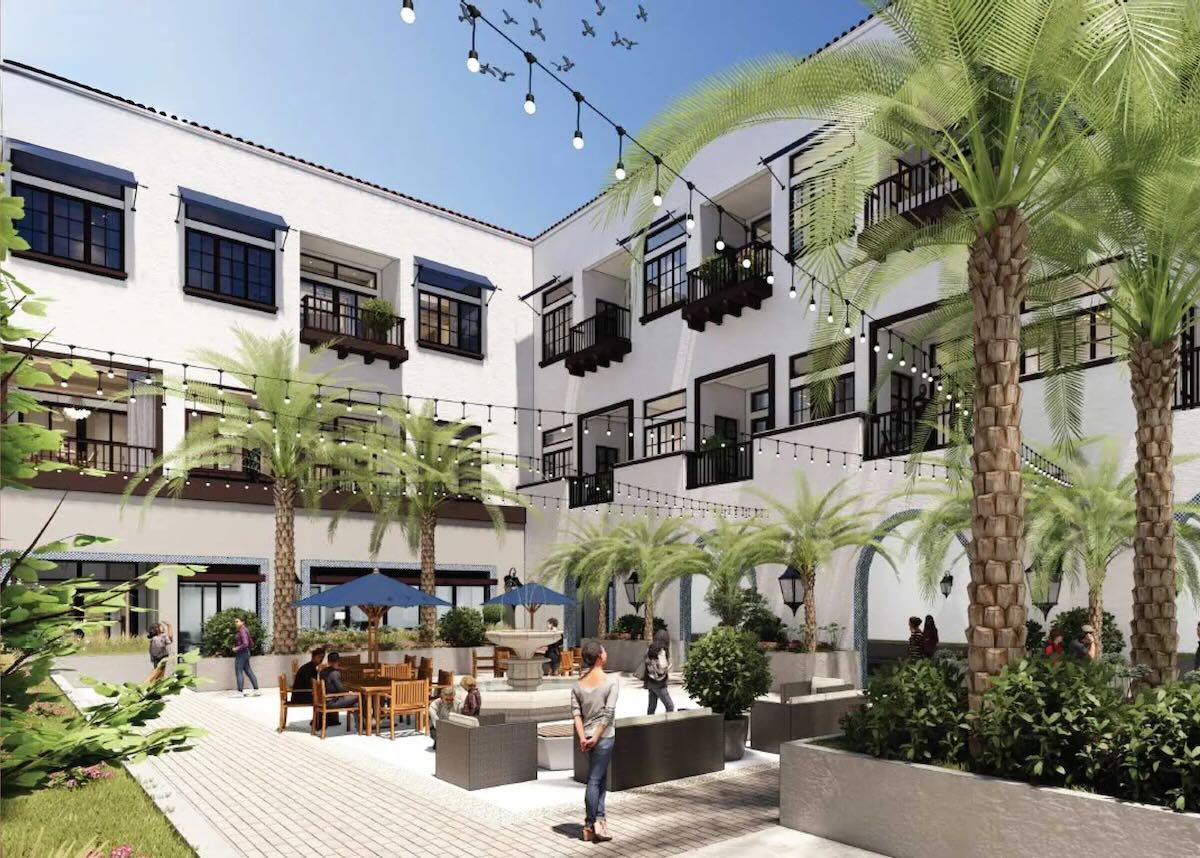
••• “City Council OKs Paseo Nuevo Redevelopment That Will Forever Change Downtown State Street,” reports Noozhawk with more than a little hyperbole. “Yardi Systems will convert the Macy’s into offices and an event space, and take over the rest of the shopping center and parking Lot #1. DSP plans to build 80-112 rental units at the former Nordstrom, and 10% of them will be affordable for moderate-income households for at least 90 years. None of them can become short-term vacation rentals.” The center of the Nordstrom building would be made into a courtyard, as in the above rendering. “The goal is to start construction on both projects in 2027.” UPDATE: SBradley’s comment below is worth a read.
••• At a meeting of Santa Barbara County’s Trails Advisory Committee, a rep for San Ysidro Ranch said that the botanical garden long in the works at the northern end of the property “includes shallow ponds for wildlife [and] is an attempt to improve on the original concept and will not impinge on McMenemy Trail. The area itself, he said, will be for hotel guests only, will not include any lighting, and will not host weddings or concerts.” —Independent
••• “New Federal Emergency Management Agency flood hazard maps went into effect last week. The new FEMA maps, or Flood Insurance Rate Maps, show the areas considered at risk of flooding and affect the cost of property owners’ flood insurance. […] The regions most likely to see changes on the new maps are the eastern portion of the city of Santa Barbara to the Ventura County line, along with some portions of the Santa Ynez Valley.” —Noozhawk
••• Why and how the city of Santa Barbara uses the herbicide Roundup. —Independent
••• Dwell got a look in the Whale House in Mission Canyon (999 Andante Road), restored by new owners Marley and Josh Raab. The article is TL;DR, but the photos, dark though they may be, are worth a look.
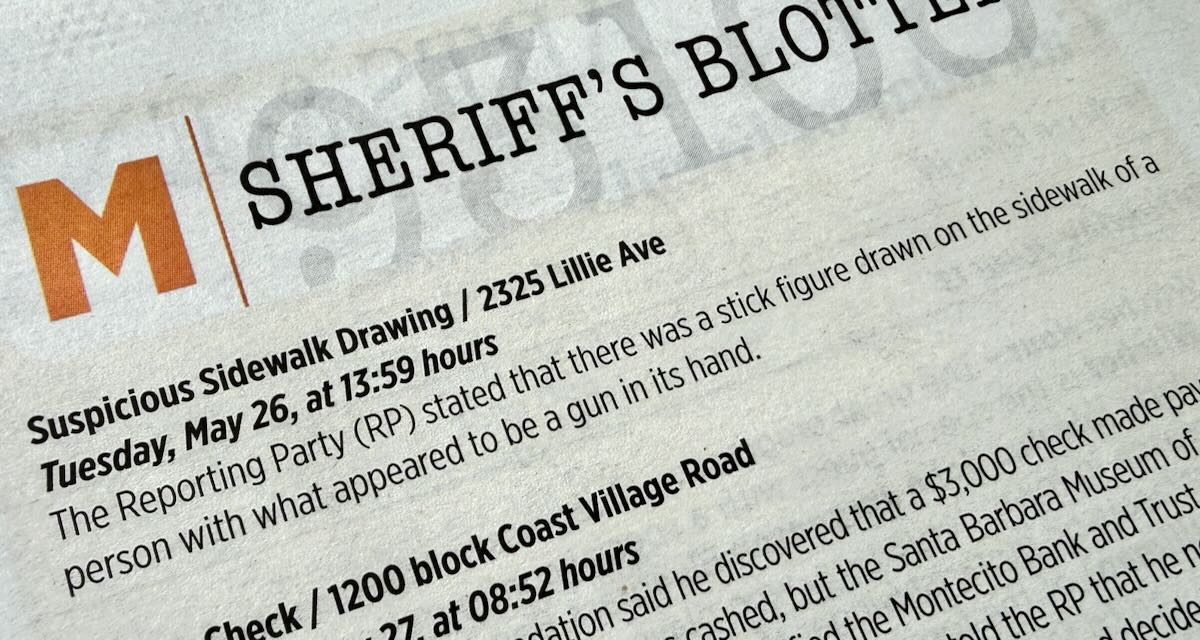
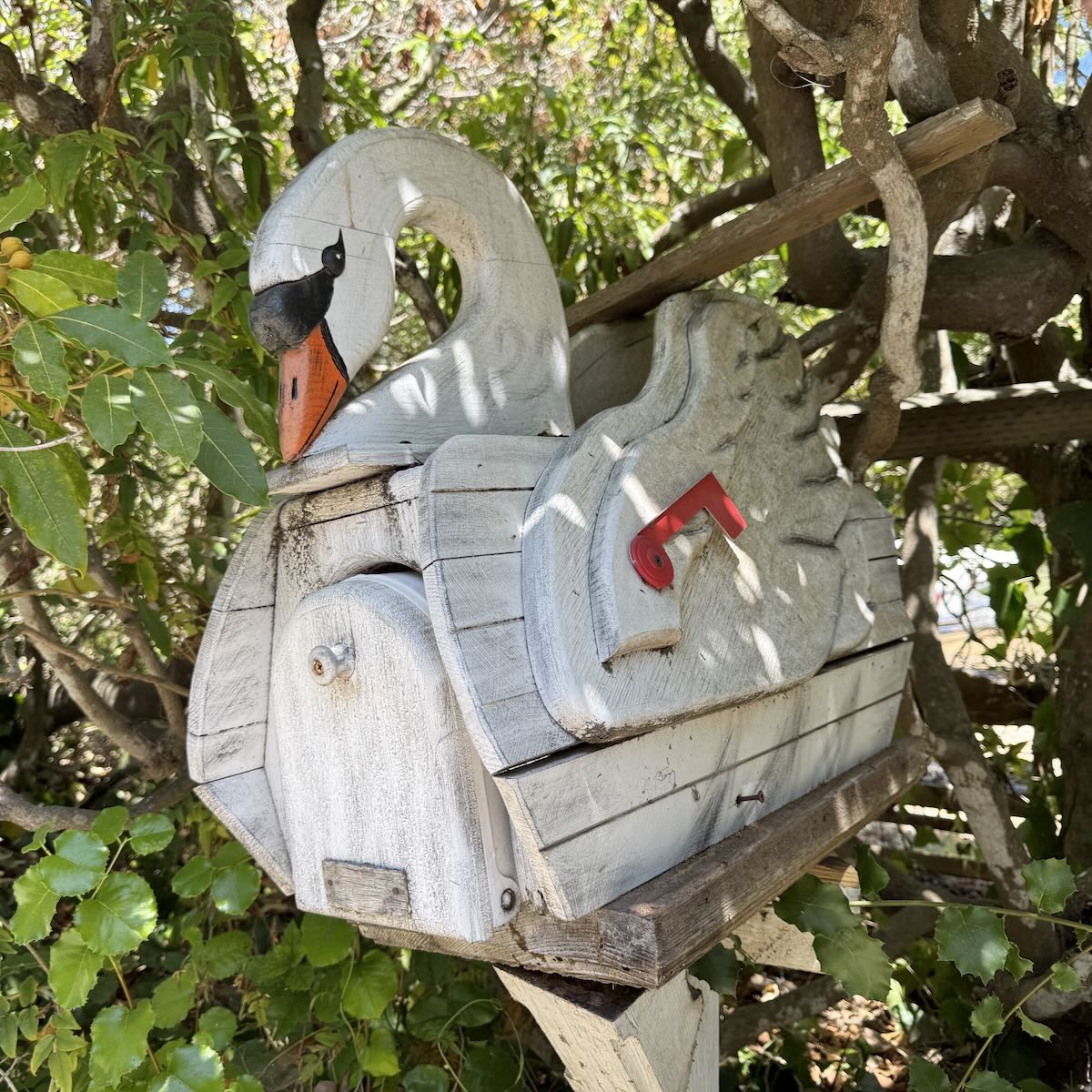
••• A classic from last week’s Montecito Journal police blotter. Don’t tell them about the game of hangman.
 ················
Sign up for the Siteline email newsletter and you’ll never miss a post.






Worth knowing about the Paseo Nuevo deal: the city is skipping the required competitive bidding process for this public land transfer by using the state-approved “Surplus Land Act exemption” that was originally obtained to enable negotiation with AB Commercial (the current owner of the Macy’s building, underground parking, and inline shopping) to develop hundreds of units of housing (including affordable) on the property. The exemption was needed because AB Commercial holds the ground lease on the property, so competitive bidding for that project was impractical. That original deal fell through, but the exemption remained on the books and is now being used for a completely different transaction — one that includes an undisclosed private sale between AB Commercial and Yardi that happens simultaneously with the city’s transfer of the land. Under the standard process, multiple developers would have competed to offer the best affordable housing terms in exchange for the opportunity to purchase public land. What the community is actually getting here is only 8 guaranteed “moderate income affordable” units as part of DSP’s redevelopment of the Nordstrom building and a $5.7 million contribution to the housing trust fund. In exchange, the community permanently gives up ownership of prime downtown land with no cash payment for the land itself. Is this a case of Yardi generously “saving” downtown, or swooping in to snatch a super sweetheart real estate deal? You tell me…
No idea whether this is a good deal for Yardi or not. Paseo Nuevo has been available for sale since 2020 with no buyers – so probably not a slam dunk otherwise it would have traded already. The surplus land act exemption was granted because the encumbrances on the property render the value to the city at close to $0 (its actually less when you consider the expenses the city is burdened with). That, however, doesn’t mean it will be worth $0 in ~38 years when the lease expires. And its a great point – the city might be better off just waiting this out for 38 years.
I think that the city’s representation of this land as having ‘zero value’ is confusing because it sums together the value of 2 distinct things — the value of the land itself, and the value of the long-term lease that ‘encumbers’ it. The value of the land itself is something that is quite straightforward to assess. The county assessor’s office does that all the time, and if you have received a property tax bill, you see the assessed value broken out into land and improvements. The value of the *lease* is less than zero, though, and presumably some sort of calculations were done to determine that the costs of keeping the lease going are greater than the land value, so that’s how we get to zero? Would be great to see these numbers. In this deal, Yardi and DSP will receive the land without the lease encumberments, so that negative value needs to be removed from the calculation to come up with the actual value they are receiving.
That is a separate issue, however, from the SLA *exemption*. The exemption is not tied to the alleged zero value, but to the real constraint in the (since failed) negotiations with ABC in that they were the leaseholder and so it was not possible to entertain bids from competitors. It might be possible to get the surplus land designation for the current deal, but almost certainly not the exemption from competitive bidding that is required to get the maximum return in terms of affordable housing development.
Just realizing I did not address your first point. The buildings on the property have been up for sale, and their value is also depressed by the fact that they come with a lease that expires in less than 40 years. That doesn’t leave much time to recoup investment in new improvements, and so makes financing those improvements difficult. What has never been up for sale is the complete property that includes both land and improvements, and no encumbrances of any sort. The ‘genius’ of this deal is that it unlocks the value of the property by removing the encumbrances on each side, instantly increasing the value of both. That is what needs to be accounted for in assessing what value the city is contributing to this transaction.
I think some folks who would consider this is a windfall for Yardi may be overlooking two things: 1)The cost to Yardi to buyout AB’s lease position. I read that AB was into their position for $120M when the prior owner defaulted. No idea how much Yardi is paying AB to recoup some of that lost investment. 2) Renovation Cost. Estimate the cost of a 135K sqft adaptive reuse office conversion on a 40 year old department store and you’ll quickly see the cost is easily $35M-$55M. So Yardi’s potential all-in costs are way in excess of the $5.7M contribution to the City’s housing and parking funds. In exchange, they get the land under the mall and bring their hundreds of employees downtown, which it seems will be a net benefit to the downtown small business, nonprofit and hospitality community. A cherry on top is the aesthetic benefit as the office conversion will be more attractive than a windowless department store.
Very interesting. If Yardi is paying anywhere near $120M + $35M + $5.7M for almost 250k empty square feet, this is going to take a very long time to work out (if ever). I can see why the city considers this a miracle. I hope it works out for everyone.
It is kind of complex to tease out who bears the risks and benefits in these projects that have public and private parties involved. I do not believe that the city was a guarantor on the financing that AB Commercial provided for the previous owner (I certainly hope not!) so that was a private business risk that ABC took on, and as it turned out, it was over-leveraged. I don’t think we really need to worry about bailing out ABC, though, as losses on some of their investments are built into their business model. Just to put this into perspective, they have over $200 billion in assets under management. So whatever deal they manage to work out with Yardi, good for them. It is just important not to mix that private-to-private transaction into the value that the land and removal of encumbrances is adding to the deal.
As for Yardi’s investments, they will be investing money into their own property, not into public property. The proposed agreement is also very light in terms of public benefit commitments beyond the one-time fund contributions when the deal closes. For the DSP portion of the deal, there is the 10% 90-year affordability covenant, and primary residence occupancy / no short term rental provision. On the Yardi side, Yardi would be required to offer only as many public parking spots in Lot 1 (the basement lot) as Yardi holds permits for in city lots 2 and 10. Beyond that there is just a 7-year commitment to maintain the current spaces for the arts (MOCA, Center Stage Theater). After 7 years, they would be under no obligation to maintain them. They will be under no binding commitments at all to maintain the inline shopping, or any other community benefit purposes for the property, so the agreement definitely leaves the door open for any sort of development and closure for private use (with the exception of the DLG easement), as far as I can tell from the documents on the project website. If anyone sees any other binding public benefits commitments in the agreements that I’ve missed, please point me to them.
Though Yardi is a commercial software developer, real development is much riskier. That business has moats, history, customer lock in and competitive advantages. Redevelopment and reuse of these old buildings is a total crapshoot. No one, including them would be able to tease out what will really happen here. They have the deep pockets to sustain plenty of errors in judgments and assumptions. And there will be plenty no doubt. The question of how much something is worth always has the same answer: What the highest bidder is willing to pay for said asset. Since Macy’s has been vacant for 10 years, the answer is zero. No large retailer would ever lease that kind of space in SB. So the building either has to be demo’d, meaning it actually has negative value, or repurposed which is very expensive and likely makes it also worth zero or even below zero. If it were raw land that would be worth a lot – if there not a ground lease with lots of life left in it. But this overground bunker known formerly as Macy’s is not surface land ready to go and it’s not free and clear. I know it’s always tempting to ask ‘Did we extract enough money out of these brave folks?’ Or, ‘Could’t they have paid more?’ Reminds of the JD Rockefeller answer ‘I just want one more dollar…’ Instead, be happy. We’re getting a revitalized downtown. Look at the big picture. The city was smart enough to do so years ago to lease this land for zero dollars. And it looks like they were smart enough to do so again. It’s a huge win in the long term. The present value of an asset if the value of it during it’s useful life. For the next 35 years, this property is worth zero due to the gratis ground lease that is in place. Try to sell land that has zero future income for 35 years and you will find, uh, zero interested parties. A smart friend of mine years ago told me to just make deals that I think are a wi. A deal that makes you happy. Don’t try to assess the other party and then try get more because you think they might pay a higher figure. That is not the way to make good deals – or any deals. Accept the bright future ahead, don’t dream the pennies, nickels or even dollars that could ruin a great thing. I’m not affiliated in any way but Yardi seems to be one of the better companies around. They seem to care about their employees and the community. And they are local. It’s okay to scrutinize a big transaction and look at details, but we should just accept the win here and look at the big pic. Megan is a real estate attorney, seems like she and the City Admin drilled down. It’s such a better development than the current owner proposed which was 7 stories tall.
John: I think we should keep in mind that Yardi is a software company that sells software *and data* for *real estate property management*. The only companies who have their level of insight into real estate property values and costs of development, operation, etc. are their competitors like RealPage (and on a smaller scale, AppFolio). Let’s also assume they want the best deal possible and are pushing for terms as much in their favor as possible (after all, that’s how you become a company with multiple billions of dollars in revenue). The only way to discover the market value of this deal — with all of the elements that are on the table now, land + improvements, no encumbrances) — is to have a competitive bidding process, which has not happened here. At minimum, there should be disclosure of due diligence documents supporting valuation, which has not happened so far.
Circling back to my initial comment: the key question about this deal is whether or not the city should be using the competitive bidding exclusion they obtained for the ABC deal to this entirely different transaction. The competitive aspect of the bidding has been mandated to produce the maximum return in terms of affordable housing, but it would also reveal a lot about the true value of the property being transferred. If we look at the Yardi portion of the deal, it is delivering exactly 0 commitment to actually build or acquire any affordable housing. If the housing trust fund spends all $5 million on administrative costs trying to arrange the rest of the capital stack for the 100-200 projected units without success, I think that would still satisfy Yardi’s affordable housing obligation under the current terms. A competitive bidding process would almost certainly produce more housing benefit.
I think development is just such a different animal. I’ve worked a little bit with very experienced developers. People who ONLY do RE development. They make mistakes all the time. They simply have more successes than failures. In other words, they get it right – costs, allowances, contingency, interest rates, recessions – about 70-75% of the time. The 20-25%, well, sometimes they lose money, sometimes they walk away. I believe Yardi’s software is in regards to managing real estate that already exits. Procore is the software for managing real estate developments and construction. Very, very different businesses. I think if there were another interested party, they would have stepped up. I agree with you that competitive bidding is usually best. But don’t think many people are crazy enough to put offices in that Macy’s building. It takes some gumption, tenancy, community buy in. When you have large projects like this, there are not many players. Sometimes, only one. And why would we not want a local group doing this? Remember, the city eliminated mandatory low bid process for construction projects a while back for a reason. When you take the lowest bid, you get what you pay for. And it always goes to someone out of town who does not care about our community. I see it all the time with workers from LA. They don’t give a rip. Yardi is local and seems like a quality company. They have a non-profit foundation. I know they treat their employees well. They probably don’t even need this, they want this. It’s not so much about profit. How could it be? The project is just kind of ridiculous, putting offices in a department store without windows on the second floor. They have great offices in Goleta. Where is Sonos? Where is Google? Where is Microsoft? Where are the Quantum Computer people who work for Google? Goleta. Surely they could afford to do this project if they really wanted to be downtown. They don’t care about creating a great office environment for their people. Or about revitalizing downtown SB. The heads of these companies do not live in the area or care about it. Why make it so complicated. Take the win. It’s great for everyone. We don’t need more studies or hand wringing. I work nearby and I’m tired of seeing a dying mall. Sorry my patience is up. If they do indeed have a home run, which is highly unlikely, good for them. I don’t disparage success or envy people who work hard and get a good outcome and help others along the way. Let’s have some progress for a change. The enemy of the good is the perfect which never happens.
Bottom line: there is an established process for these types of transactions that is designed to make sure the community residents get the best deal possible (at least in terms of affordable housing). Everyone involved with this seems to be doing all they can to keep this plan from going through that process. If this is all about the best interests of the community, why not just transparently go through the established process to make it happen? It is the collaborative effort to subvert the process that rings alarm bells for me.
Don’t ignore the opportunity costs of looking for other deals. Not only do you risk losing this deal, there’s no guarantee another deal would be better. And it would add at least 2 years until a new deal would happen. That’s years of delaying the direct parking revenue, indirect sales tax from more people in downtown, additional years of City staff time working on the RFP and maintaining the empty property, years delaying the projects the housing fund could spend the $6m on, risks losing other tenants in Paseo Nuevo, etc.
A bird hand is better than 2 in the bush
I appreciate your earnestness and tenacity and desire for process. I share it. But after 10 years of a huge vacancy, a dying mall, and then a horribly obnoxious idea from the current owner to put up 7 stories and tear down the entire beautifully designed mall, I think we have a good deal before us. I can assure you that when Macy’s was offered up for lease, every broker worth a bag of beans was out there hustling every potential opportunity. A lot of money in brokerage fees was on the table for the taking. These brokers can sell ice to an eskimo – yet – they came up with nothing. If this is being rushed, it’s because this is such an amazing opportunity for SB downtown. Many of us just want a bustling and fun city, with people around supporting good restaurants and retail. A meeting spot which for friends, family and strangers that is interesting and fun. The ever important third space. We see it in Europe everywhere but in the U.S. it’s usually in tacky indoor malls. We get State street and our wonderful outdoor mall back with this.
Agree!
I find the architecture and hardscaping very boring. It looks like it belongs in LA or Orange County. Why can’t we keep more of the Spanish Colonial Revival aesthetic, which is timeless and has character?