
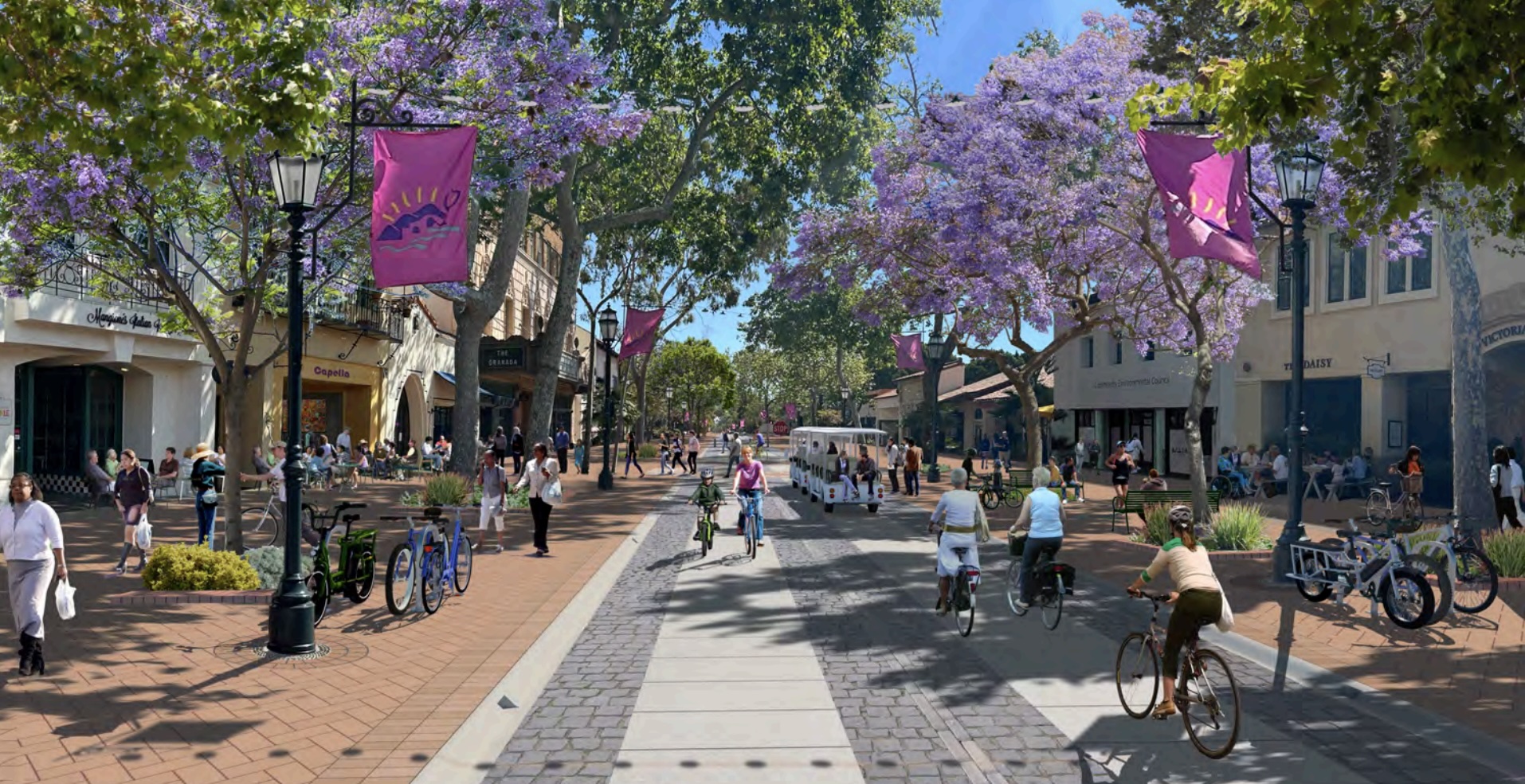
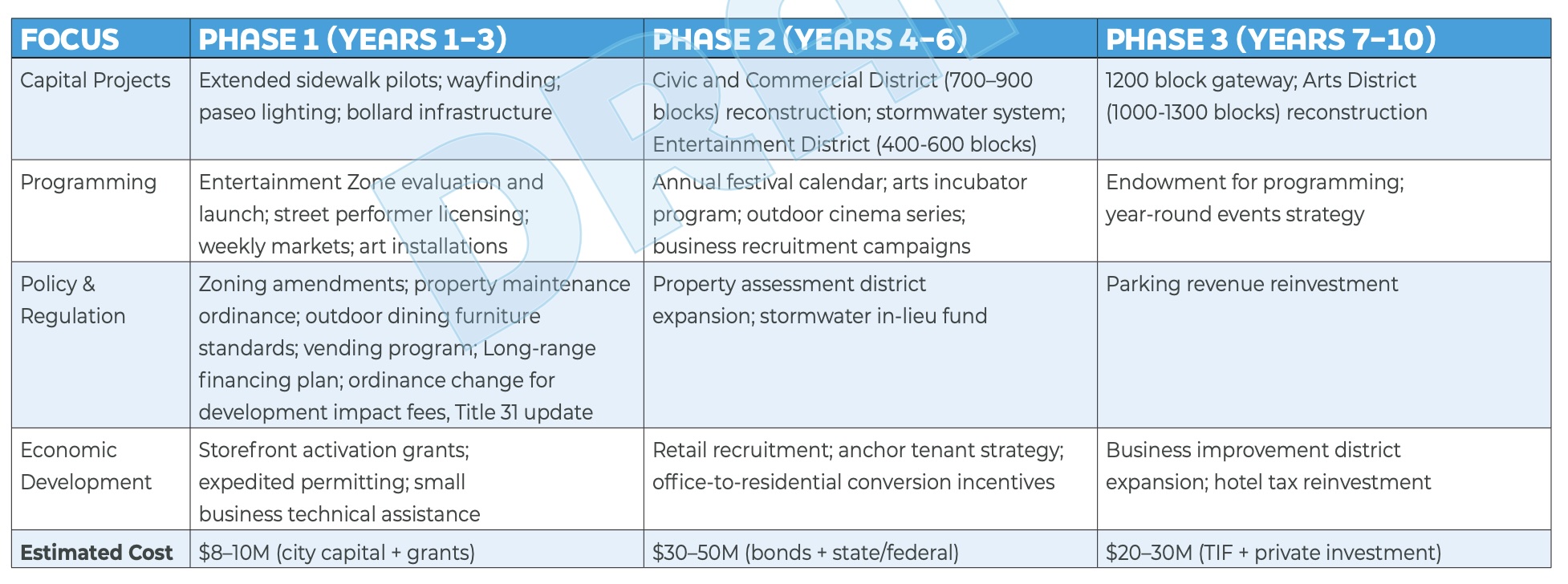
The city of Santa Barbara released a draft version of the State Street Master Plan for the 400 through 1300 blocks (between Gutierrez and Sola Streets), and it’s 153 pages. Here’s all you really need to know. You can submit comments to StateStreetMasterPlan@
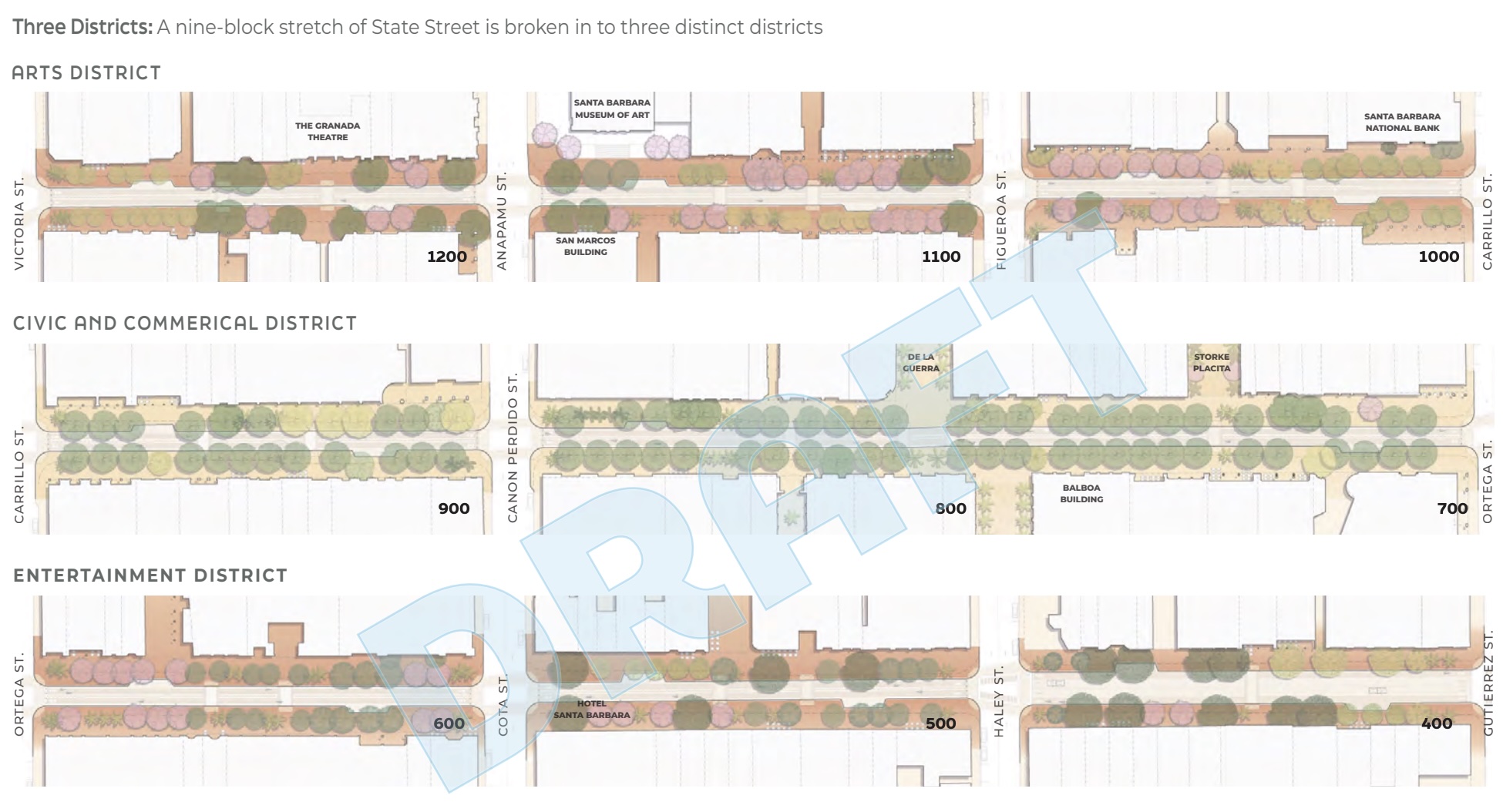
They’re still pushing the idea that the one-mile stretch has three distinct personalities.
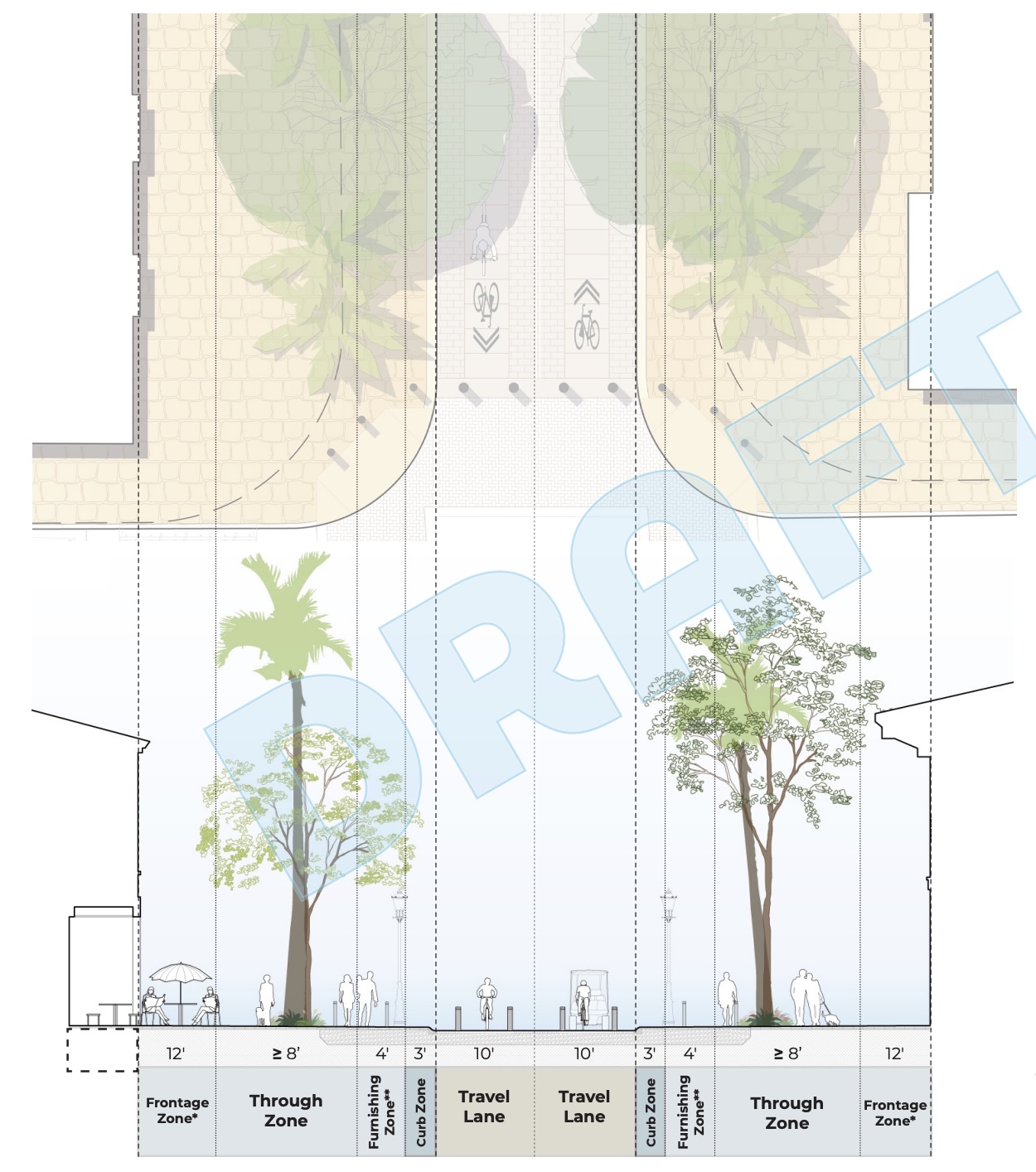
 Pedestrians and businesses get the parts near the buildings, while the center is a “travel lane” for bikes and vehicles.
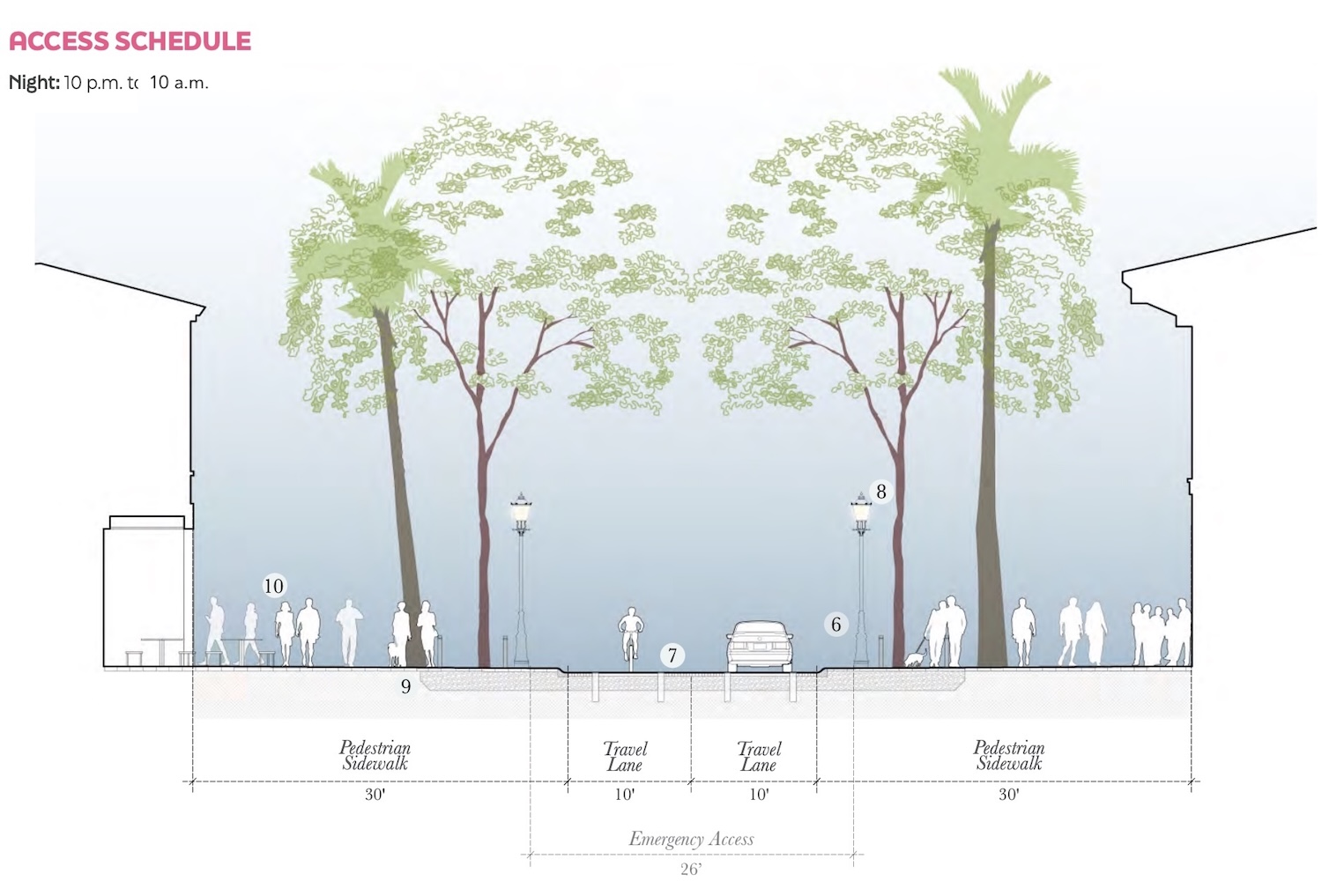
• Two 30-foot pedestrian sidewalks (~60 feet total) on either side, organized into a Frontage Zone (outdoor dining up to 12 feet), a Through Zone (minimum eight feet, clear of obstructions), and a Furnishings Zone (trees, lighting, seating, bicycle parking).
• Two 10-foot central travel lanes (~20 feet) reserved for cyclists, transit, emergency vehicles, and, during overnight hours, service, delivery, and private vehicles.
• A retractable bollard system at each intersection (8 retractable and 16-24 fixed bollards per intersection, at eight intersections) enables block-by-block control of vehicle access with a 3–8 second retraction time for emergency response.
From 10 a.m. to 10 p.m., the bollards in the travel lane get raised. “Transit vehicles and small shuttles are equipped with technology that automatically retracts the bollards upon approach, allowing them to pass through the central lane.”
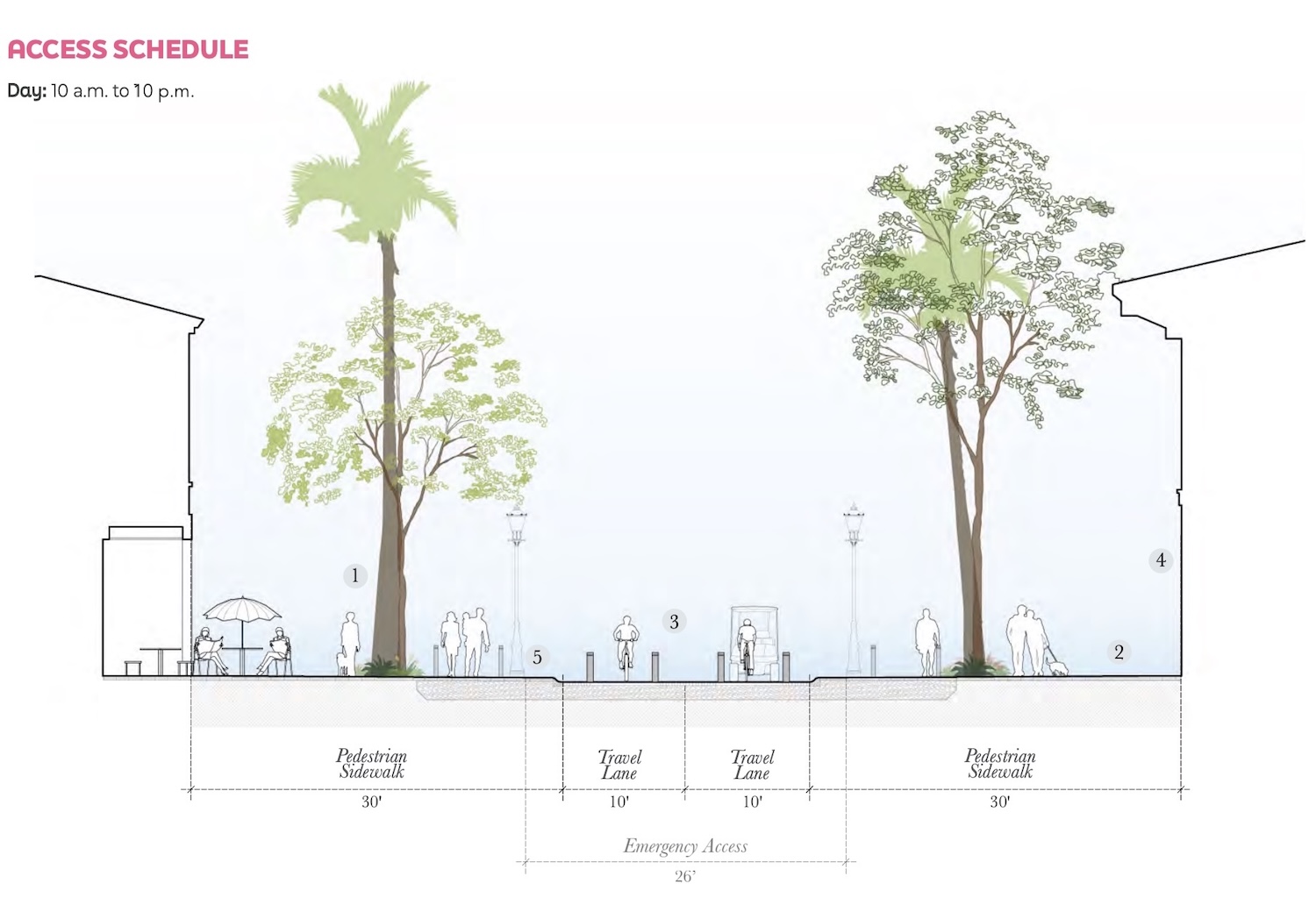
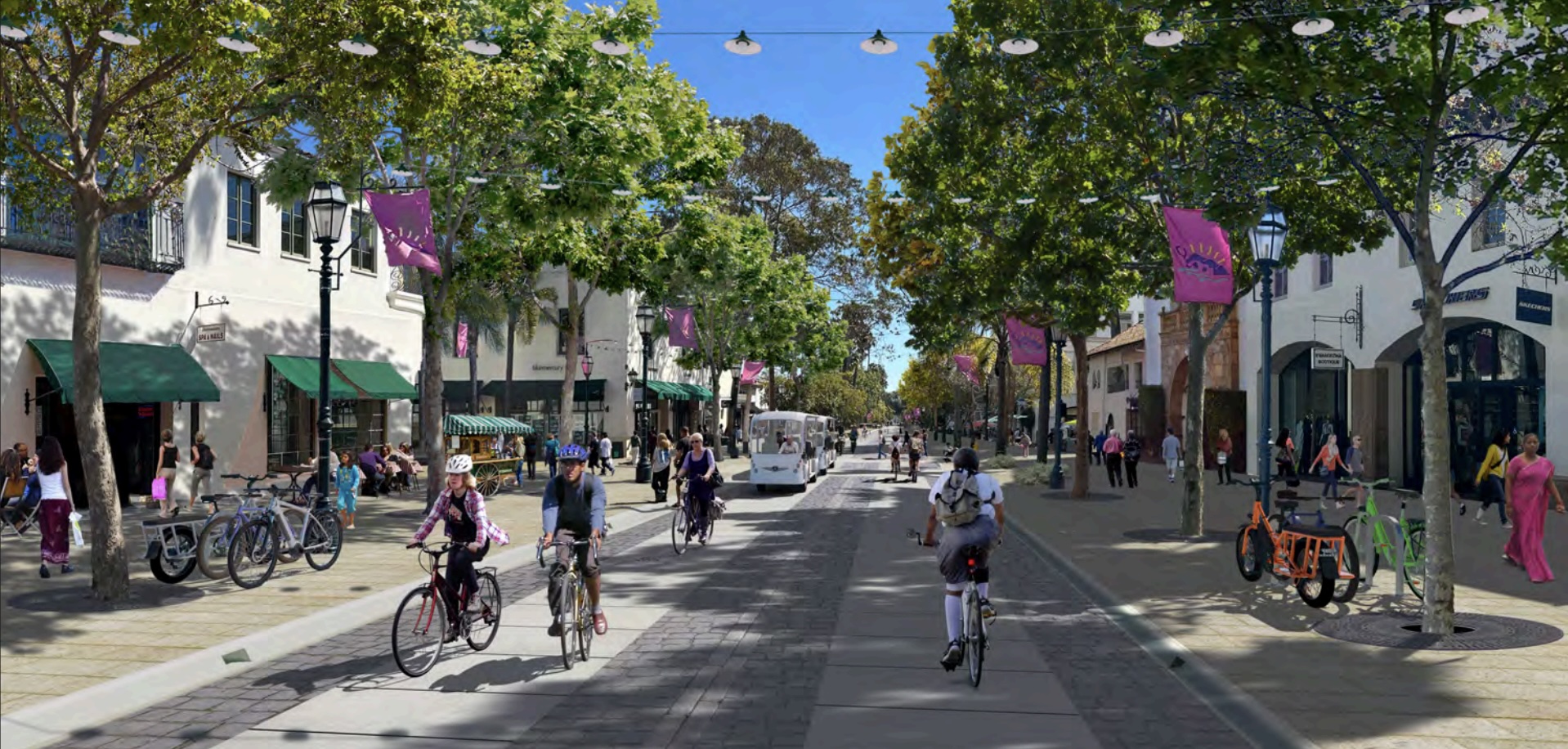 From 10 p.m. to 10 a.m., the bollards get lowered. “Vehicles allowed for deliveries, refuse collection, maintenance, and private access. A City appointment system will accommodate special construction and delivery needs outside normal windows.”
 “All users, including transit, service vehicles, and cyclists, are expected to operate at speeds of 20 mph or less.” If there’s a mention of enforcement, I missed it.
How much the transformation might cost is “still being evaluated by the civil engineering team but early estimates indicate each State Street block may cost approximately $6–$8 million.” (Underline mine.)
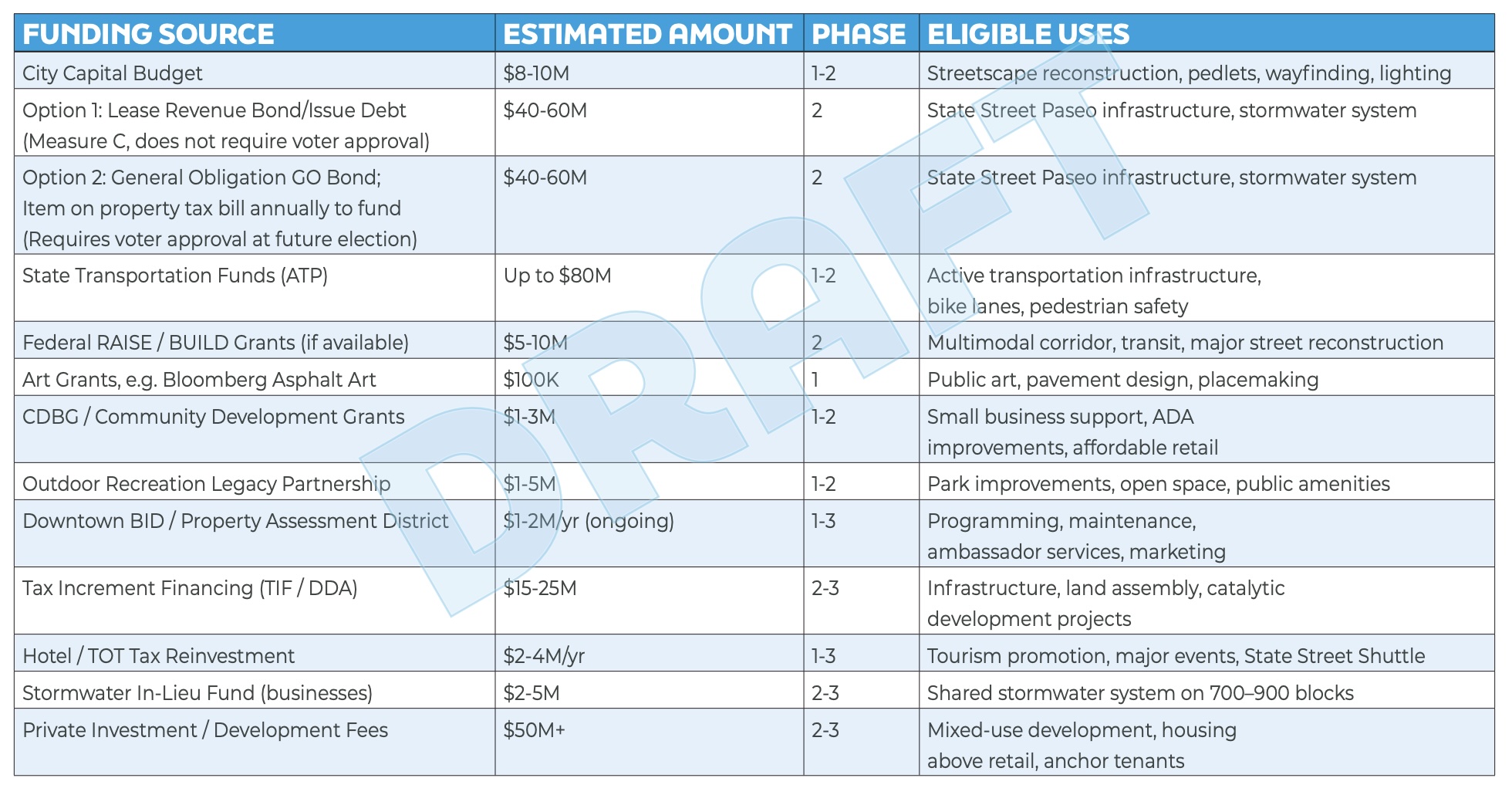 When will it happen? Not until the 2030s at the earliest.
 ················
Sign up for the Siteline email newsletter and you’ll never miss a post.





Who is supposed to pay for this design by committee monster? The empty shop owners? The people who live downtown in subsidized housing? The students making $20 an hour? The tourists buying $40 t-shirts and eating $20 burgers staying at $400 a night motels? The locals who are already taxed and fee’d at some of the highest rate in the nation? A benevolent billionaire? The city employees who graciously agree to work less for more money every year? Who?
I will take “things that will never happen in Santa Barbara” for $1000.
Sam, The history of every worthwhile civic achievement is written by people willing to see what does not yet exist and then do the hard work to make it real. If the world operated from the mindset of “it can’t be done,” we would still be living in caves. Your comment is exactly what holds cities back. It offers no solution, no imagination, and no contribution beyond reflexive cynicism.
Of course a plan like this takes funding, phasing, commitment, and creativity. That is true of every meaningful public improvement. But dismissing a bold vision because it is ambitious is not wisdom. It is small thinking. Great cities are not shaped by people whose main contribution is to point at obstacles. They are shaped by people with optimism, courage, and the ability to imagine a better future.
And since your comment seems determined to focus on what you think cannot work, let’s take those kinds of points one by one and turn them right side up:
* **“It costs too much.”**
The best public investments often do. Great promenades, civic spaces, and downtown improvements create value for decades, not just for a budget cycle.
* **“It’s unrealistic.”**
Vision always looks unrealistic to people who lack imagination. That does not make it unrealistic. It makes it ambitious.
* **“Tourists won’t care.”**
Tourists come back to places that are memorable, beautiful, walkable, and alive. That is exactly how a strong vision helps fuel the local economy.
* **“Downtown is already struggling.”**
That is precisely why bold thinking matters. The answer to decline is not more pessimism. It is a better plan.
* **“Young people working for low wages won’t benefit.”**
Students and young workers earning $20 an hour today are tomorrow’s entrepreneurs, leaders, professionals, and yes, sometimes even benevolent billionaires. Great cities invest in environments that inspire them to grow.
* **“We should only focus on what is practical right now.”**
Practicality without vision produces stagnation. Vision paired with execution is what produces greatness.
* **“The City should stop dreaming.”**
No. The City should keep dreaming, keep planning, and keep building. That is how economies grow, communities strengthen, and places become iconic.
I applaud the supervisors and planners who are willing to put forward a bold vision while absorbing criticism from people who seem unable to see beyond the next complaint. I do not like people who cannot see a better tomorrow. You are a drag on our collective optimism. Please keep your negativity to yourself and stop trying to pull the rest of us down.
Be a visionary, or be quite please, because the rest of us are trying to make things better. A.
This is NOT better, this is following the same broken idea of a promenade that no one wanted.
You are silver tongued my friend “A”. Communities grow on the concept of community, Not one set pushing ideas on others.
I have lived here for 45 years, the city should “stop dreaming”. that this is anything other than a place to LIVE for the people that live here. NOT TOURISTS. dont give me that dribble of ” how do we make money ” your community, your citizens, we spend money. but if we dont have anywhere to shop, anywhere to go that feels like us. we WONT spend money here.
stupid plans to bring money from other areas, while ignoring the “money” that is earned and used RIGHT here.
Our city’s have been turned into economies, where they should never have been. The city should not sell itself, should not market itself for tourist ‘transient” dollars. Get the dollars of the people that live here, work here, build here, and make it “iconic”.
developers that are NOT local, Owners that are 4 states away, are NOT those. they are NOT the ones to make it “iconic’….. we are. Santa Barbara locals
you know the ones that made this town what it was BEFORE it was turned into a cash grab tourist town. Progression is fine, but progression just for the fact of progression isnt always the best plan. nor is it best for a community.
stop running our cities like business’s, they are not. they are where people live.
„ you know the ones that made this town what it was BEFORE“
Interesting – so that means those are also the ones who ruined it, right?
Why are people so afraid of „others“ who want to invest their money here… the only dreamers are the people thinking anything changes with this mindset.
The world is not black and white… i enjoy the influence of new streams, ideas and people who came to this town…
If the city stops dreaming that this is a place for tourists, then it will fail. That thinking is what made Santa Barbara what it was and what it is.
I do not see Conde Naste suggesting we all go to Victorville for a vacation. I do not see Travel & Leisure suggesting that we all go to Bakersfield for that incredible experience.
Tourism has a huge direct and indirect impact on the city. All the tourists support the restaurants, the hotels, the tours, etc.
Your argument about places to shop is interesting. Why did Nordstrom, Macy’s, Sears, Borders, Bloomingdale’s, etc. all depart? Start thinking bigger picture, and you will see that it has more to do with ecommerce taking over than location. These stores did not just close in Santa Barbara. Retail is a dying business. People are demanding warehouse level of different products and are ok with getting it the next day. Heck, some are even doing what I am doing. Walmart now delivers to Santa Barbara same day. Imagine that . . . I no longer need to drive down to Ventura to purchase what I usually purchase from them. And before you go off on that, there are products that they sell that local stores do not.
I will agree, with a slight twist, that cities are not businesses in the sense that they should not generate profits. But they are a business in that they provide services citizens demand, and to support that, they need income. If you want fewer services, then, sure, they can be more of what you want.
DB you are absolutely correct that ecommerce is killing retail business. With that in mind, who then is going to rent all the empty stores on State street?
Seth, a lot of us wanted and still want the promenade. Just because the people you know don’t doesn’t mean your thinking is universal.
laughable ideas with associated costs= ridiculous!
Ah, the “if we build it, they will come” approach…. since when is spending $100M on “a hope” a wise decision?
Well said. Take the example of the Santa Barbara County Courthouse and sunken gardens built by visionaries at a considerable expense at the time (and worth it in my opinion) and compare it to the piece of 1970s dreck architecture in the county building across the street.
Well said Albert!!
When it takes that many pages and graphics to explain a simple situation, you know something is very wrong. Complicating street opening and closing days and times, forced theme “zones”, etc. are a distraction. Our downtown grew organically with people walking AND driving past businesses. The road and parking infrastructure is already there.
An added benefit of cars returning is that they will help to slow e-bikes by constricting and separating their directional travel lanes.
No, no no no no. Ask the locals. we do NOT want more sidewalks and tighter travel lanes.
I have not run into ONE local that wants anything like this.
You need to talk to more locals. I have some little squabbles with the plan but mostly love it.
Same. In my friend and work groups, this is mostly well received.
How many in your friend group own or work at a customer facing business downtown?
Just put State Street back the way it was before the Pandemic!!! It functioned well. Look at the Santa Monica Promenade, a total failure. People don’t need to walk in the middle of the street, we already have sidewalks on either side.
The promenade is a failure because the homeless numbers there increased so much there and businesses closed during the pandemic. It seems to be slowly improving with increased security and SM trying to entice businesses back with allowing open carry on the promenade, which many aren’t happy about.
From an AI search, this was an interesting summary of pedestrian zone success rates:
Most cities that “restreeted” their pedestrian zones have experienced a positive “rebound” effect.
Retail Occupancy & Sales: Reopening to cars often triggers a spike in business. For example, when Oak Park Mall (Illinois) was reopened to traffic, retail sales rose 24% within one year, and the occupancy rate increased from 75% to 80%.
Safety & Perception: Reintroducing cars provides “eyes on the street” at all hours, reducing the perception of the area as deserted or dangerous.
The “Main Street” Success: Cities like Providence (Westminster Street) and Raleigh (Fayetteville Street) transitioned from failing malls to successful “Main Streets” by allowing multi-modal traffic, which now supports a flourishing, revitalized downtown.”
I like it. But please control the e-bikes.
It’s true there is no money for this. None. Maybe there are some funds in D.C. Salud could tap into, but this broke little seaside town certainly doesn’t have the funds. Lots of money available for a new freeway evidently to bring people here. But what’s here for them when they arrive? It’s a nice dream at this point. I don’t see all the fuss about the plans. The current set up of walking and riding on a street made for cars isn’t very appealing. Going back is rarely the way forward. I don’t see how cars on the street help, if there is no parking on same street. And if you are dining on the street and a car idles nearby waiting for a light, or a loud motorcycle comes along, how is that pleasant or a reason to return? This should not be a cruise zone. That makes no more sense than letting e-bikes go 25mph or pull wheelies amidst confused pedestrians in an ill defined and liminal zone between two sides of a street which they (walkers) are contemplating crossing at a given time. It’s broke and needs fixin’. But so is the city. How to figure this one out. Despite my histrionics and light cynicism, I do sense the street is slowly fixing itself by the uncoordinated efforts of private enterprise, non-profits and educational centers (UCSB, Westmont, Film Festival, Music Academy) who are planting themselves downtown. It’s ground up that will likely work here, not top down. I gave up on the top down method a while back due to a lack of leadership, successful policies or planning. Over time, things could reboot, expenses brought under control, tax receipts increasing. So maybe in 10-15 years we see a new street, what it may be. Meanwhile, let’s dream and discuss but keep cool heads and be open. Oh, if a local billionaire or two steps up that could speed things up. But I’m not sure they care about the plight of the town. They seem to want less activity, not more. Hope they prove me wrong. I have nothing against smarts and success, but please share it a bit. You can’t take it with you but you can leave something wonderful behind. It’s what has made Santa Barbara what it is.
The facelift worked for the Funk Zone, and it “could” work here but it’s a serious, near $100m gamble. State Street is is in dire need for something “to make it work”, and opening the streets obviously isn’t the answer. I’ve seen comparisons to 3rd Street Promenade in Santa Monica, which these plans resemble, but 3rd St is going through the exact same issue as State. Online shopping, homelessness, and not enough places to visit on this section of State on a leisurely afternoon are the issues. The unique mom and pop shops can’t afford it and opening a restaurant along that stretch is almost always guaranteed financial suicide. A facelift is a step in the right direction for the filthy, urine smelling sidewalks and greasy asphalt. If this goes through, there’s still a LOT of work to do in order to make this the bustling street it once was.
This is absolute rubbish. Who decided we should turn State Street into a bike lane? We are in a budget shortfall. This is crazy town.
I would not bother with any of this until the city decides to take homelessness seriously. People sleeping all over state street this morning. It does not need to be this way.
I agree. I saw 2 people urinating on State St. One at night and one in the middle of the day. Unbelievable. Where are the police on floor patrol?
Love it. I think there should be a fund-raising campaign which would include not only building this out, but dedicated funds for keeping in clean and safe.
Santa Bárbara is killing its Golden Goose by closing State Street and making it a refuge for homeless, and teenage e-bikers. It’s dirty and smells like urine. Parking lots and walkways are dark and don’t feel safe. Vacancies are up, rents down, sales tax revenue down, parking revenue down. Meantime Carpinteria, Montecito, Milpas, Goleta, and Upper State are doing well. This isn’t complicated. The answers are right there.
Spot on.
I would disagree with the homeless refuge since I’ve noticed that not forcing people to walk in the sidewalk has made it more challenging for the homeless to panhandle and block the sidewalk.
Downtown was worse before Covid and we had one of the highest vacancy rates of any coastal downtown area- so you want to go back to that?
I work on State Street and have for the last 20+ years.
Ditto the spot on!
State Street Master Plan …. A long term visioning document to revitalization of downtown over the next 20-30 years.
Exactly. All aboard!
This plan is classic Santa Barbara. Trying to please everyone everywhere at all times. TPEET if you will. It’s cool that everyone and every voice matters. But sometimes you have to say no to someone. There is one easy way to simplify this plan: Just re-route the bikes. I say this as someone who loves to bike. (And I say this with the idea of making an adjacent street truly bike friendly with bike parking.)
I think if you want a vibrant and safe street, there is no choice. La Rambla does not allow bikes but even if they did, it’s so busy they could not possibly ride down the street. This should be the goal, to make State street crowded – with people. Start with the goal and then work backwards is much easier than trying to stuff every possible experience into less than one mile of one small street.
The improvement committee should also focus on cleaning the walkways & parking lots steps, they are filthy!
Building owners should be required to clean the area in front of their buildings
While I have said for years that the council should stop wasting money and hire Caruso to design this “plaza”, this is the most elegant and meaningful plan we have seen so far after many hundreds of thousands of dollars wasted before. Of course many locals (and tourists) want this promenade – it is a safe and beautiful place to meander, appreciating gorgeous historic architecture and mature landscaping and it leads you by the windows of retailers and restaurants to shop or have a drink/meal. Many major cities around the world have very similar walking boulevards and they are charming and successful.
How are your going to make it attractive for retailers to want to buy or rent locations
when their customers cannot drive by and see their stores. People want convenient shopping and parking out front of the stores and restaurants. There are plenty of areas to bike already in this town and plenty of room to include bikes of the street. State Street is a ghost town now, have you not looked??
Please open the street to vehicles like it was before.