
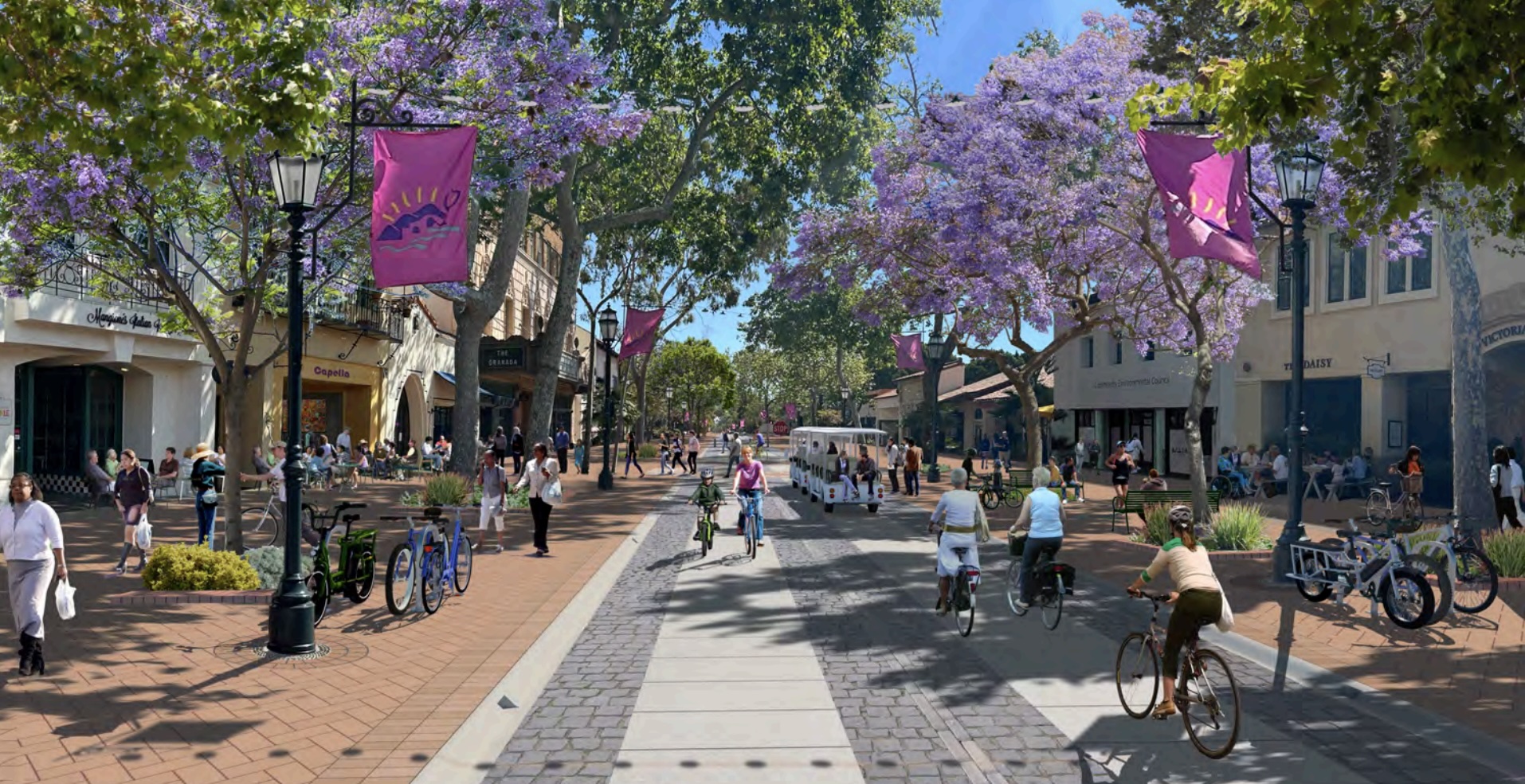
The city of Santa Barbara released a draft version of the State Street Master Plan for the 400 through 1300 blocks (between Gutierrez and Sola Streets), and it’s 153 pages. Here’s all you really need to know. You can submit comments to StateStreetMasterPlan@
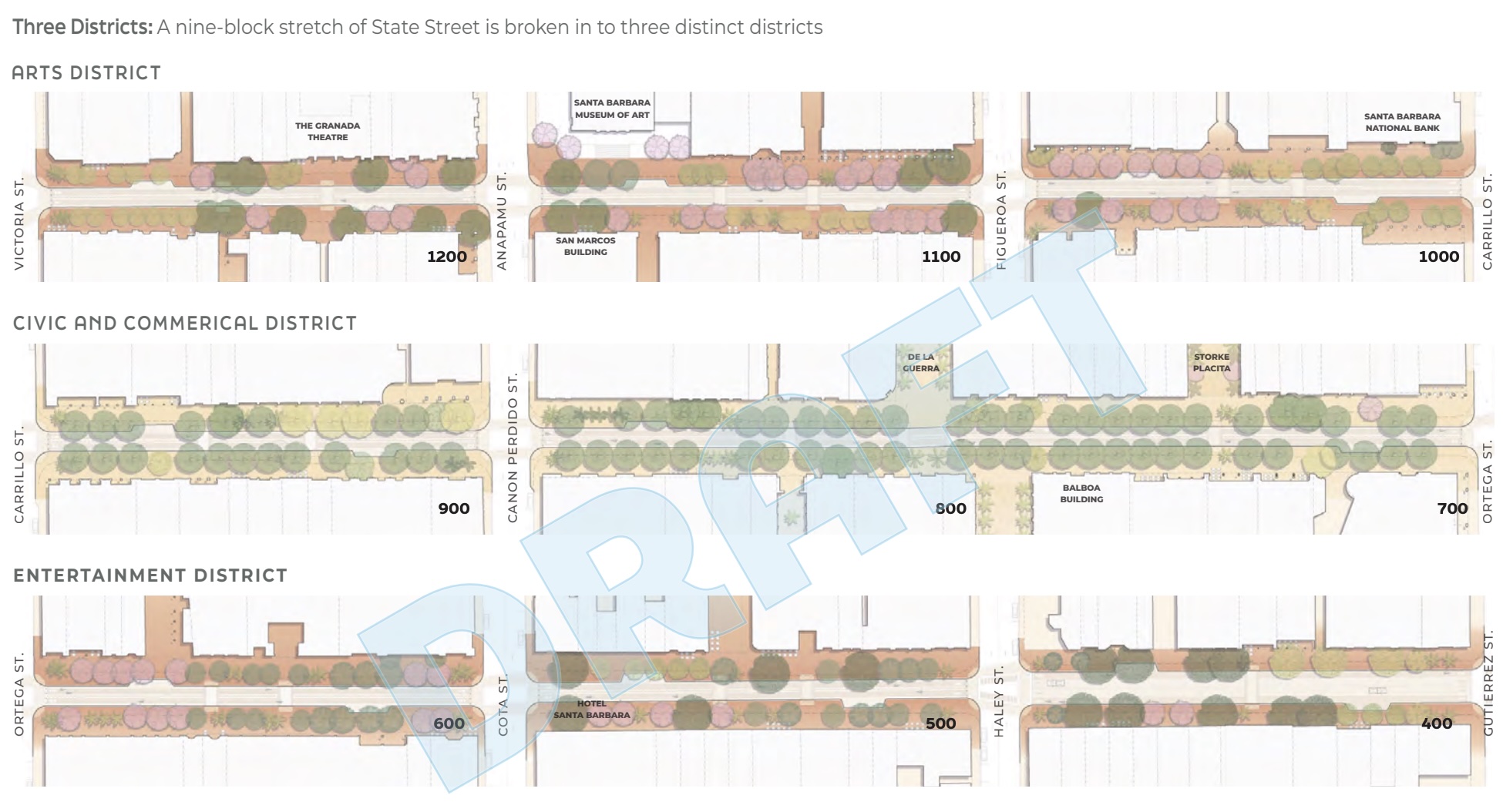
They’re still pushing the idea that the one-mile stretch has three distinct personalities.
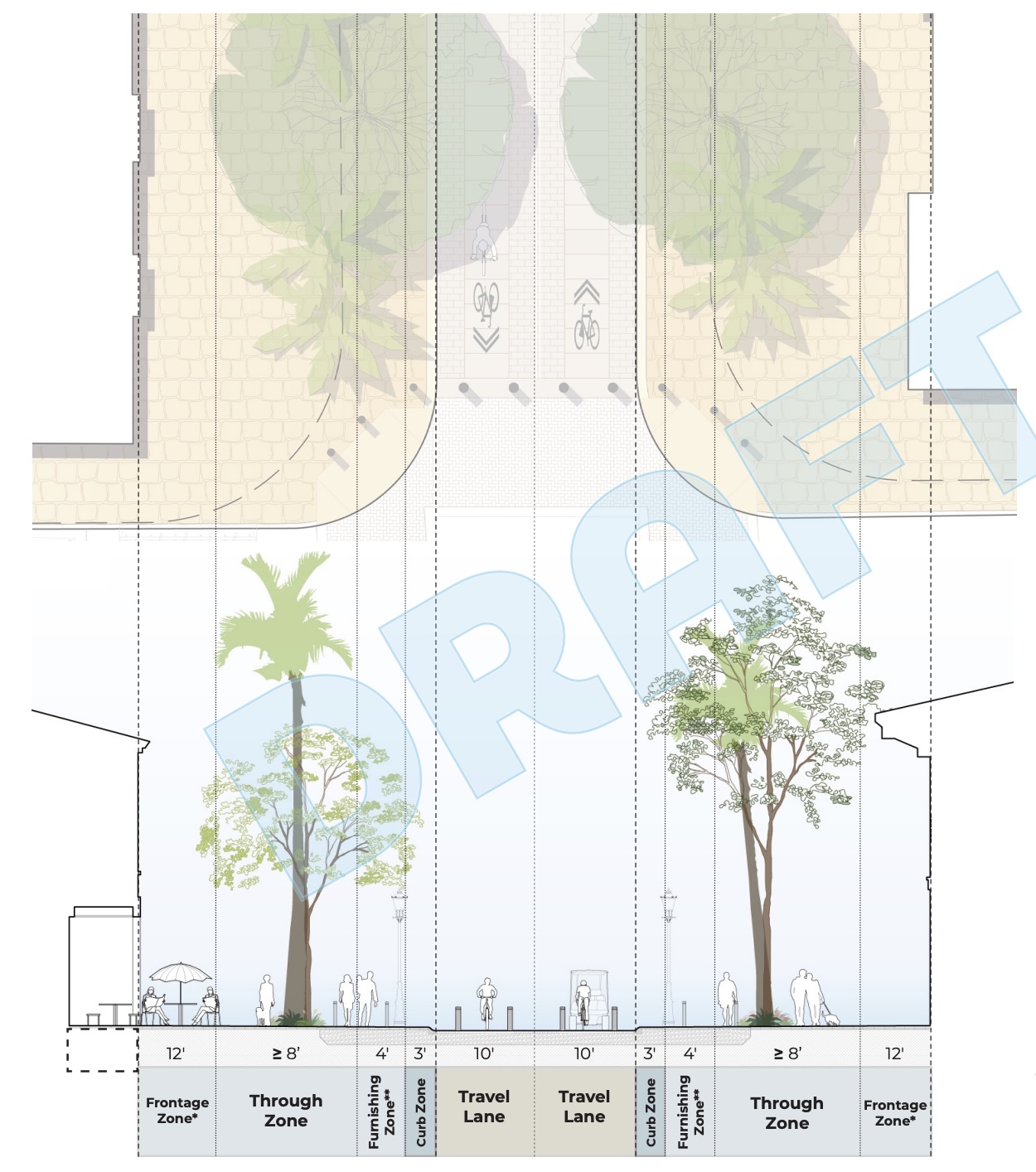
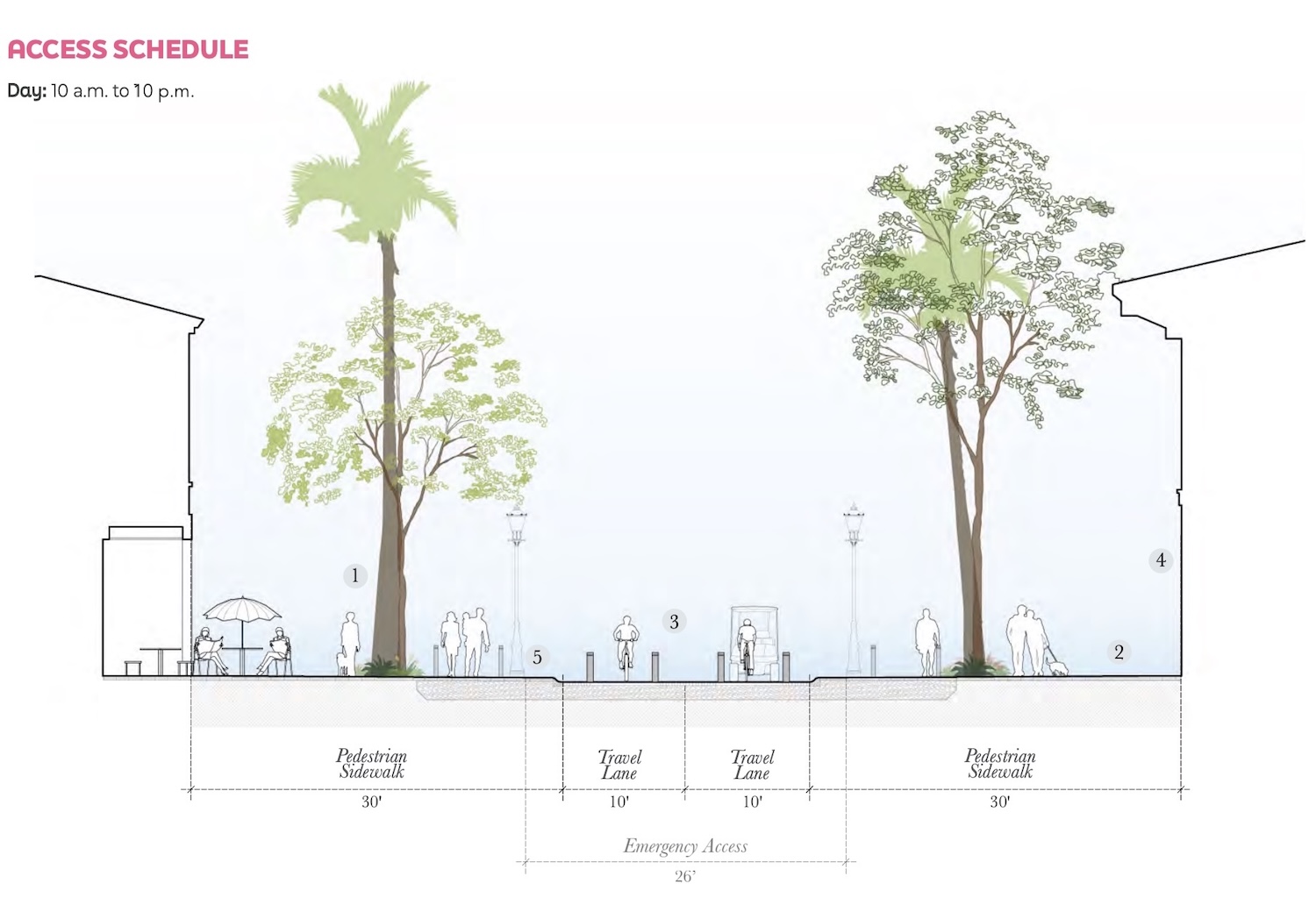
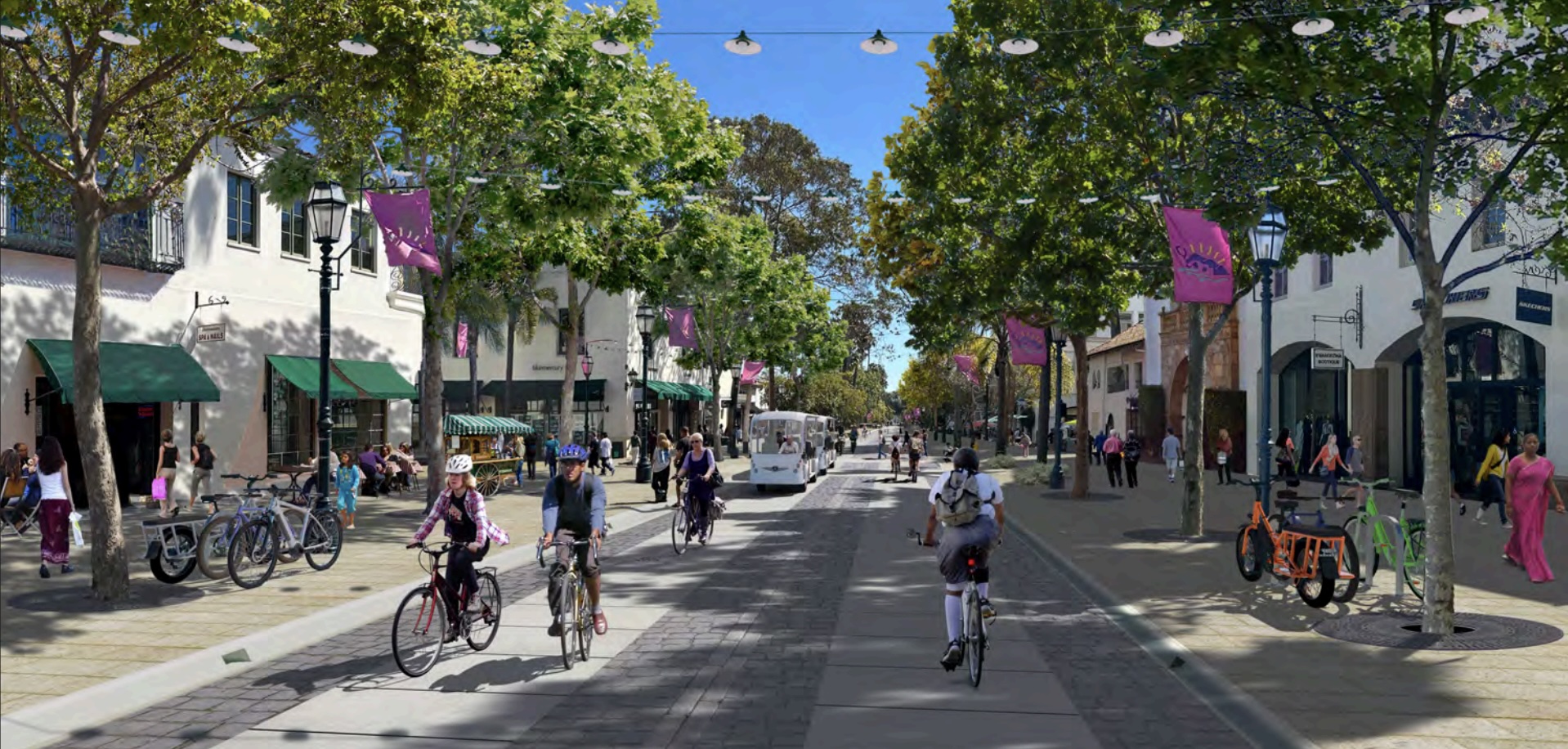
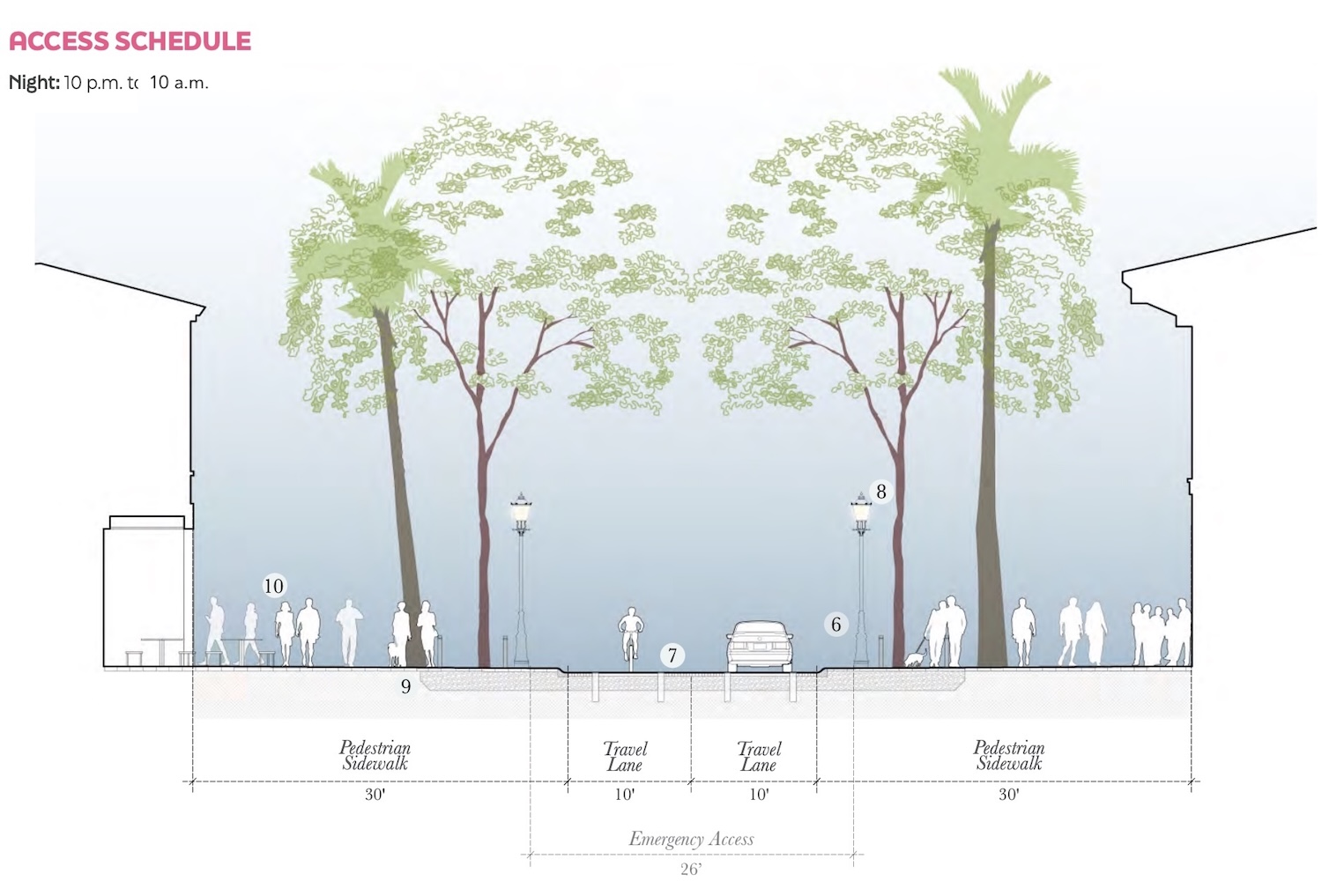
 Pedestrians and businesses get the parts near the buildings, while the center is a “travel lane” for bikes and vehicles.
• Two 30-foot pedestrian sidewalks (~60 feet total) on either side, organized into a Frontage Zone (outdoor dining up to 12 feet), a Through Zone (minimum eight feet, clear of obstructions), and a Furnishings Zone (trees, lighting, seating, bicycle parking).
• Two 10-foot central travel lanes (~20 feet) reserved for cyclists, transit, emergency vehicles, and, during overnight hours, service, delivery, and private vehicles.
• A retractable bollard system at each intersection (8 retractable and 16-24 fixed bollards per intersection, at eight intersections) enables block-by-block control of vehicle access with a 3–8 second retraction time for emergency response.
From 10 a.m. to 10 p.m., the bollards in the travel lane get raised. “Transit vehicles and small shuttles are equipped with technology that automatically retracts the bollards upon approach, allowing them to pass through the central lane.”
 From 10 p.m. to 10 a.m., the bollards get lowered. “Vehicles allowed for deliveries, refuse collection, maintenance, and private access. A City appointment system will accommodate special construction and delivery needs outside normal windows.”
 “All users, including transit, service vehicles, and cyclists, are expected to operate at speeds of 20 mph or less.” If there’s a mention of enforcement, I missed it.
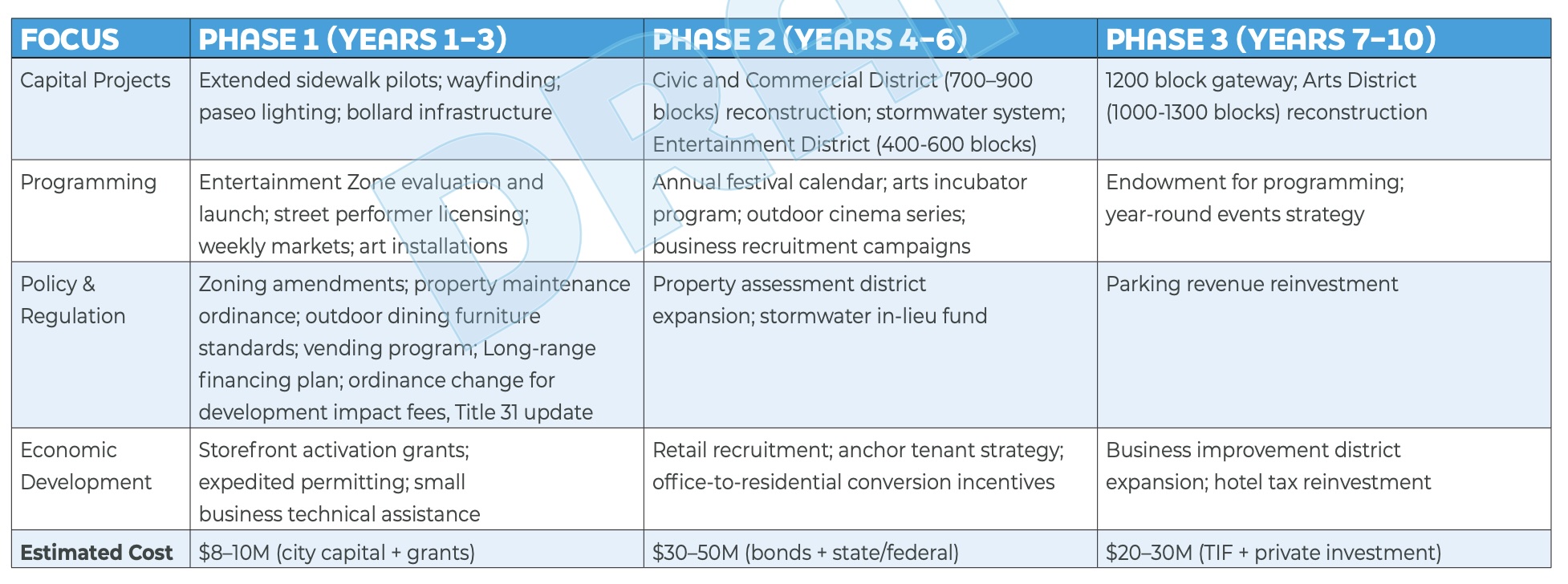
How much the transformation might cost is “still being evaluated by the civil engineering team but early estimates indicate each State Street block may cost approximately $6–$8 million.” (Underline mine.)
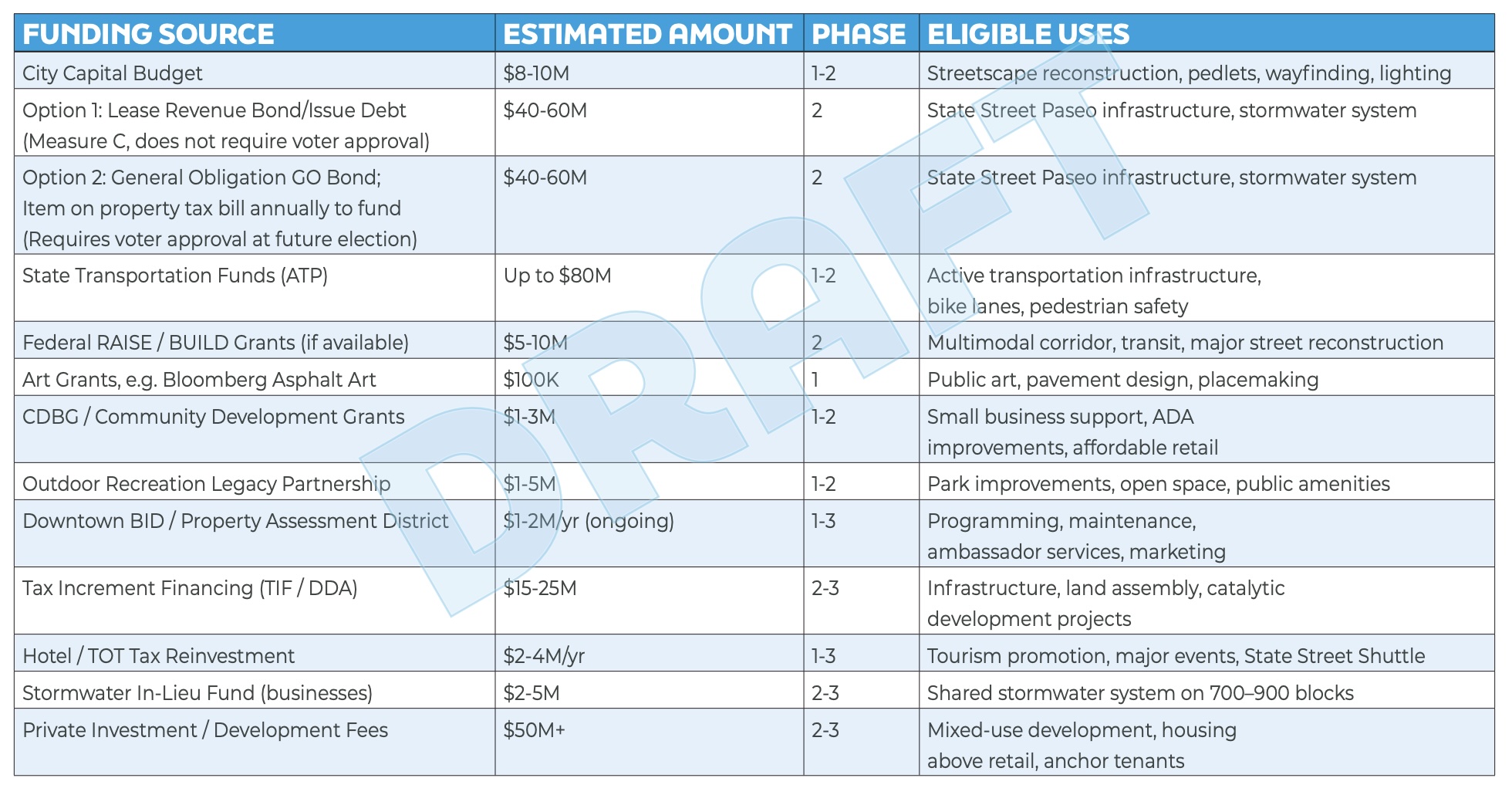 When will it happen? Not until the 2030s at the earliest.
 ················
Sign up for the Siteline email newsletter and you’ll never miss a post.







Who is supposed to pay for this design by committee monster? The empty shop owners? The people who live downtown in subsidized housing? The students making $20 an hour? The tourists buying $40 t-shirts and eating $20 burgers staying at $400 a night motels? The locals who are already taxed and fee’d at some of the highest rate in the nation? A benevolent billionaire? The city employees who graciously agree to work less for more money every year? Who?
I will take “things that will never happen in Santa Barbara” for $1000.
Sam, The history of every worthwhile civic achievement is written by people willing to see what does not yet exist and then do the hard work to make it real. If the world operated from the mindset of “it can’t be done,” we would still be living in caves. Your comment is exactly what holds cities back. It offers no solution, no imagination, and no contribution beyond reflexive cynicism.
Of course a plan like this takes funding, phasing, commitment, and creativity. That is true of every meaningful public improvement. But dismissing a bold vision because it is ambitious is not wisdom. It is small thinking. Great cities are not shaped by people whose main contribution is to point at obstacles. They are shaped by people with optimism, courage, and the ability to imagine a better future.
And since your comment seems determined to focus on what you think cannot work, let’s take those kinds of points one by one and turn them right side up:
* **“It costs too much.”**
The best public investments often do. Great promenades, civic spaces, and downtown improvements create value for decades, not just for a budget cycle.
* **“It’s unrealistic.”**
Vision always looks unrealistic to people who lack imagination. That does not make it unrealistic. It makes it ambitious.
* **“Tourists won’t care.”**
Tourists come back to places that are memorable, beautiful, walkable, and alive. That is exactly how a strong vision helps fuel the local economy.
* **“Downtown is already struggling.”**
That is precisely why bold thinking matters. The answer to decline is not more pessimism. It is a better plan.
* **“Young people working for low wages won’t benefit.”**
Students and young workers earning $20 an hour today are tomorrow’s entrepreneurs, leaders, professionals, and yes, sometimes even benevolent billionaires. Great cities invest in environments that inspire them to grow.
* **“We should only focus on what is practical right now.”**
Practicality without vision produces stagnation. Vision paired with execution is what produces greatness.
* **“The City should stop dreaming.”**
No. The City should keep dreaming, keep planning, and keep building. That is how economies grow, communities strengthen, and places become iconic.
I applaud the supervisors and planners who are willing to put forward a bold vision while absorbing criticism from people who seem unable to see beyond the next complaint. I do not like people who cannot see a better tomorrow. You are a drag on our collective optimism. Please keep your negativity to yourself and stop trying to pull the rest of us down.
Be a visionary, or be quite please, because the rest of us are trying to make things better. A.
This is NOT better, this is following the same broken idea of a promenade that no one wanted.
You are silver tongued my friend “A”. Communities grow on the concept of community, Not one set pushing ideas on others.
I have lived here for 45 years, the city should “stop dreaming”. that this is anything other than a place to LIVE for the people that live here. NOT TOURISTS. dont give me that dribble of ” how do we make money ” your community, your citizens, we spend money. but if we dont have anywhere to shop, anywhere to go that feels like us. we WONT spend money here.
stupid plans to bring money from other areas, while ignoring the “money” that is earned and used RIGHT here.
Our city’s have been turned into economies, where they should never have been. The city should not sell itself, should not market itself for tourist ‘transient” dollars. Get the dollars of the people that live here, work here, build here, and make it “iconic”.
developers that are NOT local, Owners that are 4 states away, are NOT those. they are NOT the ones to make it “iconic’….. we are. Santa Barbara locals
you know the ones that made this town what it was BEFORE it was turned into a cash grab tourist town. Progression is fine, but progression just for the fact of progression isnt always the best plan. nor is it best for a community.
stop running our cities like business’s, they are not. they are where people live.
When it takes that many pages and graphics to explain a simple situation, you know something is very wrong. Complicating street opening and closing days and times, forced theme “zones”, etc. are a distraction. Our downtown grew organically with people walking AND driving past businesses. The road and parking infrastructure is already there.
An added benefit of cars returning is that they will help to slow e-bikes by constricting and separating their directional travel lanes.
No, no no no no. Ask the locals. we do NOT want more sidewalks and tighter travel lanes.
I have not run into ONE local that wants anything like this.
Just put State Street back the way it was before the Pandemic!!! It functioned well. Look at the Santa Monica Promenade, a total failure. People don’t need to walk in the middle of the street, we already have sidewalks on either side.